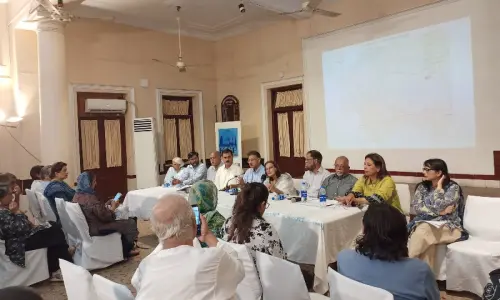
KARACHI, June 5: A book titled Kitabein Apne Aaba Ki by eminent broadcaster Raza Ali Abidi was launched at the Arts Council Karachi on Tuesday.
Speaking on how the idea of the book came about, Mr Abidi said in 1975-76, while working for the BBC, he presented a proposal to his bosses that the relatively less known books written by 19th century Indian authors (which could be found in the India Office Library) should be discussed in a programme.
They gave him the green signal for 14 weeks. Once the show, Kutub Khana, went on air, it received a wonderful response in terms of fan-mail and the programme was given an extension — it ran for 140 weeks. A few years ago, he (Mr Abidi) decided to collect the scripts of the show, which he had gathered in four files, and began compiling them. As a result, Kitabein Apne Aaba Ki saw the light of day.
Mr Abidi said when he first joined the BBC he was taught to love his voice. Thirty years on he realised it was his listeners that he should love. He said in his career he developed a rapport with his listeners and could tell who was lending an ear to his programme. He thanked media person Farhad Zaidi for editing the book and working hard on its publication.
Dr Pirzada Qasim, who presided over the event, said whoever got hold of the book should think they had found a treasure trove.
He suggested the book launch should have been an occasion to appreciate Mr Abidi’s efforts, for conscientious nations always showered praise on their educated, enlightened individuals. He said if there were younger people in the audience, he would have told them that Mr Abidi was an example of how a human being added value to his personality — by virtue of acquiring education, by doing painstaking research, etc.
Prof Sahar Ansari began his speech by taking note of the large number in which the audience had turned up.
He said many journalists did shows on the BBC but Raza Ali Abidi’s were noteworthy. Quoting T.S. Eliot, he said the way Shakespeare accomplished a lot by only reading Plutarch’s account of Greeks and Romans, Mr Abidi had also achieved a similar feat.
He then touched on the 100 books that had been discussed in Kitabein Apne Aaba Ki, including one written by the 10-year-old Raj Bahadur titled Larkon Ka Khel. Prof Ansari’s anecdotal reference to Shaikh Imam Bakhsh Nasikh, taken from the book, amused the audience.
Dr Jaffer Ahmed read out a detailed paper on the book and its author.
He said Mr Abidi’s writings created a kind of gentleness (gudaaz) in the reader. The quest for knowledge and the mild nature of the writer unwittingly got transferred to the reader.
He told the gathering that while defining quality poetry Faiz Ahmed Faiz had once remarked that it (poetry) instilled in the reader the urge to create. Mr Abidi’s prose had the same effect. He said when the author of the book wrote Gernaili Sarak we tended to look at the road (constructed by Sher Shah Suri) differently. When he penned Rail Kahani, it filled us with romance for trains.
Dr Ahmed said the 100 books mentioned in Kitabein Apne Aaba Ki were written in the time when the East India Company held sway in the region. They were kept in the British Library to inform the reader about the political, social and linguistic (in terms of the Urdu language) ups and downs that took place in the 19th century. Those incidents infused us with a historic consciousness, he commented.
Apart from Maulana Hali’s Majalisun Nisa and the debate on whether Umrao Jan was Urdu’s first novel, he in particular mentioned a book about ‘thugs’ and how the thugs at the time used a codified language. Shakil Adilzada lauded the author’s endeavour and talked about how in Kitabein Apne Aaba Ki the common mistakes in the (written) Urdu language that people made were mentioned.
Aqeel Abbas Jafri read out a brief paper and said the author had discussed the book Akhlaq-i-Hindi, which was written as far back as 1803 by Mir Bahadur Ali.
Wusatullah Khan conducted the event.