0
0

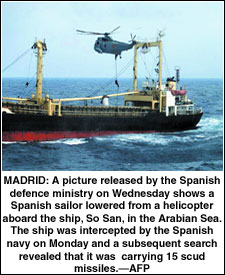 WASHINGTON, Dec 11: The United States will allow Yemen to take possession of a shipment of Scud missiles seized by US and Spanish forces in the Indian Ocean, US and Yemeni officials said on Wednesday.
The decision came after Yemeni President Ali Abdullah Saleh discussed the incident with US Vice-President Dick Cheney and assured Cheney the missiles would be used only for the defence of his country, officials in Washington said.
Yemeni officials said on Wednesday they bought the missiles some time ago for their armed forces. Foreign Minister Abu Baker Al Qurabi assured the United States that the missiles would not reach any third party, the Yemeni news agency SABA reported. The ship was intercepted on Monday by a Spanish frigate acting on information from US authorities.
“While there is authority to stop and search, in this instance there is no clear authority to seize the shipment of Scud missiles from North Korea to Yemen. And therefore, the merchant vessel is being released,” said White House spokesman Ari Fleischer.
Yemen’s foreign ministry sent a letter to the US ambassador protesting the interception of the Sosan by the Spanish Navy, and the seizure sparked urgent consultations between US and Yemeni officials.
At the Pentagon, US officials said that before Monday’s seizure, Yemeni officials had denied the inbound shipment belonged to them.
Earlier, US officials had defended the seizure, saying it was consistent with a newly-announced Bush administration policy to interdict shipments of arms capable of carrying weapons of mass destruction.
Fifteen complete Scud missiles, 15 conventional warheads and 23 containers of nitric acid were found on board the vessel, Spanish Defence Minister Federico Trillo said.
US officials stressed the ship did not appear to be headed to Iraq, which used Scuds in 1991 during the Persian Gulf War. The ballistic missile can have a range of up to 400 miles, but it was unclear what type of Scud was aboard the ship.
Initially, the capture was reported in the US media as another major breakthrough in the war against terrorism, assuming that the missiles were meant for some terrorist outfit in the Middle East.
But on Wednesday, the confiscation led to a diplomatic row between the United States and Yemen, which is helping US forces against Al Qaeda and other terrorist groups in the Middle East, when the Yemeni government claimed the missiles belonged to its armed forces.
US officials privately admit that the ship wasn’t doing anything illegal if indeed it was intended for Yemen and not Iraq. Neither North Korea nor Yemen are part of the missile control treaty which would prohibit them from buying or selling missiles. And if it was not doing anything illegal, what was the rationale for seizing the cargo.
Earlier on Wednesday, the Yemeni government summoned the US ambassador in Sana’a to lodge a formal protest against the vessel’s seizure.
“The cargo belongs to the Yemeni government and its armed forces for defence purposes, and it will not reach a third party,” said the letter Yemeni Foreign Minister Abu Bakr al Querbi delivered to US Ambassador Edmond Hull in Sana’a.
The news agency said the cargo of missiles was part of a contract “concluded very long ago.”
Al Querbi also handed over a letter of protest to the Spanish government. On Tuesday, the US State Department confirmed that a coalition force intercepted a merchant ship in the Arabian Sea that was carrying a dozen Scud missiles of apparent North Korean origin.