0
0

YOU’D think the job of a book description involves point-blank lying to fool the readers into buying the book. You know nothing obviously, because here’s a book where the book description is trying to pass a quasi-academic lecture off as a sales pitch. The description on the jacket of Ali Akbar Natiq’s collection of stories, Qa’im Din, introduces him as follows:
Urdu afsane mein haqiqat nigari ne dobara apni hesiyat, balke apni afadiyat manwa li hai. Qayam-i-Pakistan ke das barso’n ke andar alamati afsana haavi ho chuka tha… (Realism has reclaimed its place in Urdu fiction; in fact, it has convinced us of its value. Within 10 years of Pakistan’s independence, the alamati afsana had dominated the Urdu literary scene...)
It goes on for a bit so I’ll paraphrase the rest: For too long, Urdu fiction has mucked around in abstract stories (alamati kahani is the term of choice. It means many things, but mostly it refers to deviants from conventional realist modes of writing.) Urdu fiction must now come back to earth and start telling us stories about REAL people, REAL places and REAL situations. Ali Akbar Natiq has done it. He’s awesome. Buy the book. (Okay, it doesn’t say buy the book.)
One thing is clear: this book description isn’t looking for potential buyers. It is only speaking to Urdu writers and critics who love the alamati kahani. At all events, regardless of what one thinks of the larger landscape of Urdu fiction and the narrow definition of ‘realism’ so deeply cherished by the author of this description, it is a pretty accurate summation of what Natiq delivers in his debut collection of short stories, which has been received enthusiastically by the Urdu literary community.
Leading critics and writers, including Shamsur Rahman Faruqi, Ajmal Kamal and Mohammed Hanif have hailed Natiq as a fresh new voice in Urdu literature. (Mohammed Hanif has also translated a story from this collection, “Me’mar ke Haath” into English for Granta; it is a very fine translation and available on the Granta website as “Mason’s Hands”.) It wouldn’t be wrong to say that this is the giddiest the Urdu literary community has felt about a collection of stories in recent years. That in itself is not to be taken lightly.
The major distinction of Natiq’s stories, duly noted by all the critics who have commented on his work, is their ability to capture the scenes and rhythms of the Punjabi countryside. All these stories are unfailingly good in their ability to portray the lives of characters in a Punjabi rural setting. Natiq exhibits a particular flair for character with an enviable range: his stories feature characters that include Chaudhrys, gravediggers, pirs, dogfighters, thieves, scandal mongers and elopers and more and more. Yes, when it comes to profusion of characters, these stories keep giving.
It is no surprise then that the standouts of the collection are the five longer stories. These are the stories that allow Natiq’s numerous characters to find their space and express themselves. It is also in these stories where Natiq is able to chart his characters’ development over a longer course of time with fine results: the scenes in these stories are solid, the pacing is steady, and Natiq’s facility with language admirable throughout.
However, most of this collection comprises relatively shorter pieces (eight pages or less). These stories lack the finish and the imaginative flourish of the longer ones and do little more than provide reportage-like snippets of village life. That works too, but the impact is necessarily very limited.
THE best story in this collection by far is “Mominwala ka Safar”. It is a comic story set in a Model Village which is battling the menace of herons that for some unknown reason have settled in the thickets of trees in the village. In order to get rid of the pest, the village folk reach the difficult consensus of cutting down the branches of the trees. But when this plan is executed, it leads to the carnage of hundreds of heron eggs and babies that fall and get injured and killed. The spectacle provides Naziran — the village tattler and scandalmonger who commands great fear and respect for her tongue — an opportunity to take the chairman of the village council to the cleaners. The story is an account of Naziran attempting to abuse the chairman and the latter tactfully trying to ward off the punishment that she is bent on delivering. The story, like others in the collection, has a surprising end but it is in the tradition of best short fiction — it not only surprises but also gratifies the reader.
As for the other longer stories here, while Natiq does a fine job dramatising character and setting, his stories end predictably. Almost all the stories have a similar end — accidents. The characters in his stories are rarely devastated by their own choices; instead, they are undone by things like bad luck and deadly floods. The result is that promising stories are often lost to what comes across as a hasty end, and at its worst, a didactic urge on the part of the author. A good example of this is the story “Me’mar ke Haath” — one of the strongest in the collection.
“Me’mar ke Haath” features the mason Asghar who specialises in making minarets. Although he has an established practice in his local village, he departs for Saudi Arabia to seek greater fortune and glory against his father’s wishes. The story follows him through his travails at the Jeddah airport and city to Mecca and observes him wandering the alleys in Medina, where he is deceived, swindled, and ultimately, arrested for thievery. The story contains beautiful, surreal sequences but the end is so stark, so sudden and so complete that it spectacularly reduces this intriguing story into a fable. The sense of life ends with the last line of the story.
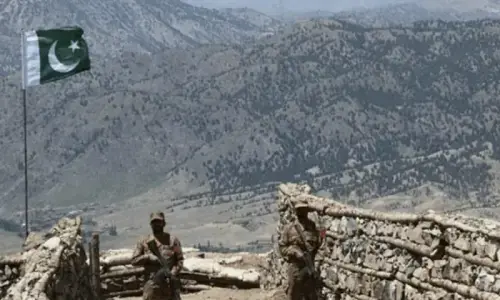
It is pretty much the same case with the other great hero of this collection, Qa’im Din, a thief who has mastered the treacherous forest terrain on the Pakistan-India border close to his village. Every few months, he carries out heists where he slips through the forest (repelling cobras with a holy charm and cutting down the wild boars) to reach the villages that lie on the Indian side of the border where he makes off with several buffaloes at a time. Strong, smart and sensitive, Qa’im Din has all the qualities of a powerful mythic hero. But his fate is also sealed swiftly and suddenly. He is bludgeoned and executed twice over, and on both instances, it is little more than a conspiracy of the heavens.
Fatalism of this sort flattens Natiq’s narratives and sucks out whatever pathos the characters generate in the readers, replacing it with a forgettable pity of the kind we are used to reading in the daily newspapers. Such endings also show a heavy-handedness and haste on the part of the author.
But it is a testament to the strength of this work that even with its weaknesses, this collection is enough to establish Natiq as an astute storyteller and an inescapable writer for anyone interested in contemporary Urdu fiction. All critics who have commented on Natiq’s work agree that this collection of stories sets high expectations for his future as a fiction writer. There is no gainsaying the fact that Ali Akbar Natiq is the most exciting debut in Urdu fiction in recent years and this collection of stories deserves a wide readership.
The reviewer is a writer and translator. He teaches at LUMS.
Qa’im Din (Short stories) By Ali Akbar Natiq Oxford University Press, Karachi ISBN 9780199062881 114pp. Rs325