0
0

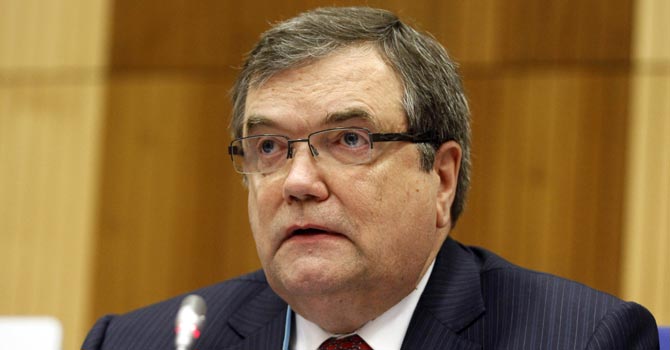
VIENNA: Talks on ridding the Middle East of nuclear weapons looked in doubt on Tuesday as the Western official organising them said he had yet to secure the needed attendance of all countries in the region.
The statement by Finnish diplomat Jaakko Laajava at a meeting in Vienna was a sign of the difficulties involved in getting Israel, its arch foe Iran and other Middle East nations to sit around a table this year to discuss the divisive issue.
Laajava, whose appointment was announced by the United Nations last October, did not say which countries were still leaving their attendance unclear, but both Iran and Israel are believed to be among them.
Underlining the deep divisions on the issue of weapons of mass destruction, Iran and Arab states used the Vienna meeting on the nuclear Non-Proliferation Treaty (NPT) to repeat their criticism of Israel over its assumed atomic arsenal.
Egypt, which originally proposed talks on creating a nuclear arms-free Middle East, said such a conference would represent a crossroads for Arab states and warned that “its failure would invite them to revise” their nuclear policies.
It did not elaborate, but the wording may be interpreted as a veiled warning regarding Arab states' commitment to the NPT, a pact designed to prevent the spread of atomic arms.
Israel is not a member of the voluntary 1970 pact so was not represented in Vienna but the United States warned that “continued efforts to single out Israel ... will make a (Middle East) conference increasingly less likely”.
Egypt's plan for an international meeting in 2012 to lay the groundwork for the possible creation of a Middle East free of weapons of mass destruction was agreed at an NPT review conference two years ago.
“ACHIEVABLE” GOAL
In his first public briefing on the issue since he took up the job, Laajava told delegates in Vienna he had held a series of meetings with regional states and they shared the goal of establishing such a zone, but they differed on how to do so.
“Unfortunately, while much has de facto been already achieved in these consultations in terms of identifying common ground, I cannot yet report that the conference will be attended by all states of the region,” he said.
Laajava said Finland was prepared to host the meeting any time during 2012, suggesting December was a possibility. Iran and Arab states see Israel's assumed atomic arsenal as a major threat to peace and stability in the Middle East.
Israel - widely believed to be the only regional state with such arms and the only one outside the NPT - and the United States regard Iran as the region's main proliferation threat, accusing Tehran of seeking to develop such weapons.
The Jewish state has said it would sign the NPT and renounce nuclear weapons only as part of a broader Middle East peace deal with Arab states and Iran that guaranteed its security.
Israel does not rule out taking part in the planned conference, Foreign Ministry spokesman Yigal Palmor said last week, but added it was “awaiting clarification on some issues”.
Thomas Countryman, US assistant secretary for international security and non-proliferation, told the meeting in Vienna that a Middle East free of weapons of mass destruction was an achievable, but long-term, goal.
However “a comprehensive and durable peace and full compliance by all countries in the region with their non-proliferation obligations” was needed for this to happen, he said.
Mark Fitzpatrick, a director of the International Institute for Strategic Studies think-tank, said the rationale for creating a zone in the Middle East free of nuclear weapons and other weapons of mass destruction was stronger than ever.
It could “be an answer to the Iranian nuclear crisis that threatens to spark regional proliferation and engulf the Middle East in another war” and “remove the sense of double standards over Israel's nuclear programme”, Fitzpatrick said in a report.