3
3

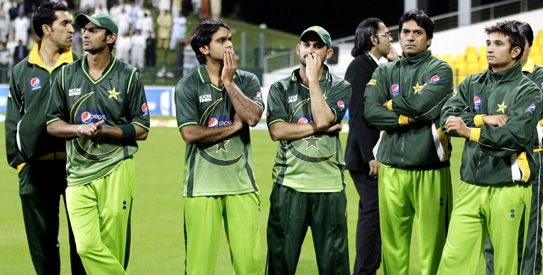
After an exhilarating and entertaining contest spanning 40 absorbing days, the series with England has finally concluded. Pakistan eclipsed England with a Test whitewash, England replied in kind during the ODIs, and the T20 series went down to the wire—in fact to the very last ball. As a cricketing extravaganza, you really couldn’t ask for more.
For Pakistan, overcoming England 3-0 in the Tests represents arguably their greatest Test achievement to date. Prior to this, our hallowed landmarks had been individual Test victories, such as Oval 1954, Sydney 1977, Bangalore 1987, Leeds 1987, and Georgetown 1988. Each was part of a drawn series. While this 2012 performance in the UAE wasn’t Pakistan’s first whitewash (defined as victory in all Tests of a series comprising three or more matches), the previous instances had all been on home soil and against teams that were struggling—over a depleted Australian side in 1982, over New Zealand in 1990, over West Indies in 1997, and over Bangladesh in 2003.
England, on the other hand, had come into this series as the top-ranked side in the world. They were keen to establish dominance in Asia, which is regarded by all ambitious international sides as the final frontier (in much the same way that Asian teams regard victory in Australia).
Pakistan’s phenomenal Test success in comprehensively overpowering such a confident and formidable outfit is largely attributable to clever and careful planning. As a team, they sat down to study their opponents’ strengths and weakness, and mapped out a bold strategy keeping in mind the expected nature of the pitches and the playing conditions. Credit ultimately goes to captain Misbahul Haq and coach Mohsin Khan for ensuring the ideal mix of discipline and motivation that allowed their daring tactical planning to bear fruit.
Misbah’s greatest captaincy achievement was to instill in his men a deep will to fight. This was Pakistan’s perpetual Plan B: if the worked-out strategy failed, they were still determined to fight all the way. The end-result was an array of memorable performances—from Saeed Ajmal, Abdur Rahman and Umar Gul in bowling, and from Younis Khan, Azhar Ali, and Asad Shafiq in batting—that are going to stay with us for a very long time.
Admittedly, the 4-0 ODI defeat that followed took some of the gloss off Pakistan’s Test triumph. There are multiple reasons why Pakistan succumbed so flatly in the ODIs, including improper selection, sketchy fielding, absence of a frontline wicket-keeper, and England’s remarkable resilience and capacity for a backlash. The single most important factor, however, was Pakistan’s abject batting failure, a foundational weakness that was exposed in the T20 matches as well.
To this extent, the dark cloud of the ODI defeat came with a silver lining, in that the fragility of our batting line-up was uncovered rather than papered over. There is a crisis of batting in Pakistan and this issue must be confronted head-on. In Test matches, which are ultimately won because the bowling side takes 20 wickets, Pakistan succeeded through the effectiveness of its bowling arsenal (the bowlers were assisted by some inspired batting, but the batting overall remained inconsistent). Limited-overs cricket, in contrast, is won by the strength of your batting, in which Pakistan was found wanting.
Pakistan’s road to further cricket progress therefore begins with a long and hard look at our batting inadequacies. Simply put, Pakistanis have never been able to bat as well as the best in the world. Even some of our most hallowed names remained overshadowed during their playing days by great Indian, Australian, and West Indian contemporaries. This is in contrast to Pakistan’s best bowling legends, who have been peerless in their craft.
It all boils down to the three famous Ts of batting—talent, technique, and temperament. Pakistan’s deficiency is most marked in the latter two areas, and this is best demonstrated by examining our three rising batting stars, Azhar Ali, Asad Shafiq, and Umar Akmal, who represent the future of Pakistan’s middle order. While their rich talent is not in doubt, their habit of self-destructive dismissals exposes faulty technique, and a lack of big scores places a heavy question mark on their temperament. At the moment Pakistan is enjoying the upstroke of an impressive cricketing revival. The team’s batting predicament must be tackled as our top-most priority if this trend is to be sustained.