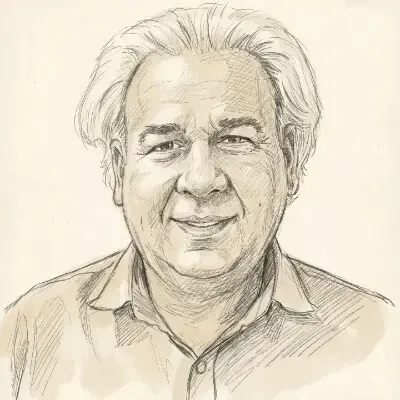
KARACHI, Jan 27: Speakers shed light on the life and work of renowned artist Jimmy Engineer at the launch of his biography, ‘In Search of My Master’, penned by noted art critic Marjorie Husain at a club on Friday.
Recalling his journey as an artist, Jimmy Engineer said he was five years old when he began drawing pictures with powder and water colours. At the age of six, he fell ill and doctors told his parents that both his kidneys had failed, he said.
By the grace of God he recovered and ever since had been painting because of Him. Later on he got into the National College of Arts and opted for the design section because he was told that being there assured a job. But he was interested in fine arts and would always be found in the fine art section. Then the question of the efficacy of having a degree arose for which he walked out of the college to see whether holding a degree mattered or not, he said.
Jimmy Engineer said people used to ask him why he made different types of paintings, to which his reply was that he was a student, a pupil of art and would never acquire mastery over it. There’s only one Master, Al Musawwir, and hence the name of the book.
He said he loved his country and wanted to project its positive image abroad. He told the audience that he was a disciple of Sufi Barkat Ali from Faisalabad, who in 1979 held his hand and made him sit on his gaddi. After that the Sufi asked his other disciples to sing the national anthem and said his job was done. This meant that Jimmy Engineer was meant to serve Pakistan, the artist and rights activist claimed. He then talked about his project of painting Allama Iqbal’s Javednama, which he completed in 1982. Jimmy Engineer said Pakistan required good, selfless human beings. He informed the gathering that he wanted to change the life of special children and worked for that cause. He said he was involved in more than 50 walks for different causes and during one (in 1994) from Karachi to Peshawar he saw a lot of suffering. From then on he decided that one should reach out to the sufferers.
He argued that Pakistan had the best of minds and kind-hearted people two of whom were Abdul Sattar Edhi and Dr Adeeb Rizvi.
He concluded by saying that Pakistan would improve if its people improved their thinking and intent.
Critic Marjorie Husain said writing was a lonely profession, but for ‘In Search of My Master’ it was a team that put together the book. She said they had tried not to put too much information on Engineer’s social work and instead talk about only his art.
Still the aspect of a social crusader had come into the biography here and there. She said the book, divided into sections, covered a large part of his work. For example, she added, there was a section on his partition paintings.
S.M. Shahid, who has edited the book, said Jimmy Engineer was a painter on the move. He was a realist but had also dabbled in symbolism. He said that the artist had traits of both European Renaissance painters as well as eastern miniaturists. While the Renaissance artist drew nobility in confined spaces (palaces etc), Jimmy Engineer painted ordinary people and situations. His use of natural light had also made him closer to the impressionists but his canvas was larger. He said the artist had a dual distinction of being both in the field of art and social service, which not many artists had.
Art collector Arif Bukhari said Jimmy Engineer’s personality had moved him because he was a great human being.
Publisher of the book Pervez Iqbal apprised the audience of how the idea of the book came about and how his team went through different stages of the publication.
Waqar Malik and Atif Bajwa also spoke.
Tauqeer Muhajir conducted the event. Prior to the official launch of the book, an exhibition of Jimmy Engineer’s work was held.