0
0


NEW DELHI: India and Pakistan said Wednesday they were closer to an agreement on a pipeline to import gas from Turkmenistan that would signal a further warming of economic ties between the traditional rivals.
Turkmenistan has the world's fourth-largest gas reserves and energy-hungry India and Pakistan are both eager to tap this source through the pipeline that would run through the Central Asian nation's eastern neighbour, Afghanistan.
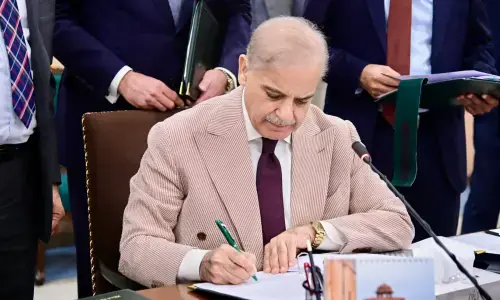
“There has been considerable progress in our talks,” said Indian oil minister S. Jaipal Reddy after a meeting in New Delhi with his Pakistani counterpart, Asim Hussain, on energy cooperation.
The 1,700-kilometre (1,050-mile) TAPI pipeline, aims to transport over 30 billion cubic metres of gas annually from the Dauletabad gas fields in southeast Turkmenistan.
“The issue of transit fees is being discussed with Afghanistan. A joint strategy is being evolved between India and Pakistan,” Hussain said.
“Whatever deal we reach will apply to both countries,” Reddy added.
Reddy said Pakistan would also consider a proposal to import Indian petroleum products and cited the savings in freight costs for Pakistan as several Indian refineries are located near the border.
Deepening economic engagement between the neighbours is seen as crucial to lasting peace in the South Asian region.
The Asian Development Bank estimated the cost of the TAPI pipeline in 2008 when the four countries signed a framework agreement at $7.6 billion.
Reddy said conflict-racked Afghanistan, which also desperately requires gas, was “very keen on the project” and had pledged security for the pipeline.
But energy experts have said instability in the region could yet scuttle the plan.
“We consider it a pipeline of peace,” Reddy added. “Everyone needs gas.”The minister indicated that an earlier plan for a pipeline to carry gas from Iran to Pakistan and then India was now on the backburner.
“We do what is more easily possible,” Reddy said, referring to the Turkmenistan project.
Washington, which has spearheaded sanctions against Iran over its nuclear programme, favours the TAPI pipeline and has pressured both India and Pakistan to hold off on a pipeline deal with Tehran.
Reddy said New Delhi was continuing to import oil from Iran and was not bound by new sanctions imposed by the European Union on the Islamic Republic earlier this week.
“We, as a member of the UN, are obliged to follow UN sanctions. Other sanctions imposed by big blocs of countries —we can have some freedom there,”Reddy said.
Iran is India's second-largest oil supplier after Saudi Arabia.