6
6
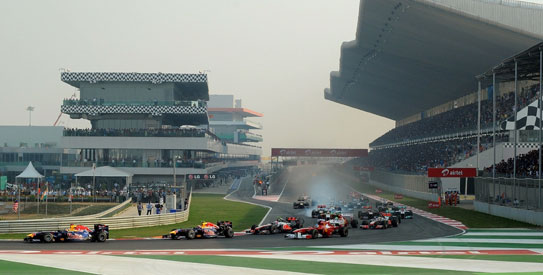
GREATER NOIDA: India is known for a love of sports and an inability to organise them but that perception shifted this weekend with a successful Formula One grand prix.
The country cringed over New Delhi's shambolic Commonwealth Games but just a year later, well-heeled Indians at Buddh International Circuit were enjoying facilities that were not just finished, but impressive.
Drivers praised the fast, smooth new course, and the wave-shaped main grandstand, rising like a mirage out of the countryside smog, is the world's second-largest at a race track, organisers said.
“It's wonderful, very good. No issues. Good food and plenty of it, and the track is beautiful,” said 30-year-old Arindam Pal, an IT worker from New Delhi.
“I'm watching Formula One for the first time, so it's like a dream come true to see it live.”Bollywood stars descended on the venue, incongruously set on a barren development site near New Delhi, while India's idolised cricketers were mobbed by undignified media scrums.
Helicopters helped the super-rich beat the traffic, Virgin's Richard Branson chatted with F1 chief Bernie Ecclestone and dozens of mini-skirted pit girls turned heads as they trooped through the paddock.
It was like a scene straight out of Monaco -- except it was in ramshackle India, where hundreds of millions of people live below the poverty line.
Outside the circuit, mustachioed soldiers with long bamboo canes marshalled cars, a lame donkey limped along the roadside and cows wandered around the skeletal high-rises which will become a major housing centre.
The striking disparity between the expensively built venue and the poverty of its surroundings was noted by many of the hundreds of foreign journalists, and even the Formula One drivers.
And India gave a reminder of its renowned chaos when a huge traffic jam snarled roads near the circuit, and a Metallica concert, organised in line with the grand prix, ended in chaos when it was cancelled at the last minute.
But for the grand prix's private-sector organisers, who eschewed government help to the point of not even inviting the sports minister, it is a project that will help attract wealth not just to them, but to the country at large.
“This is not about Formula One. After the Commonwealth Games India's image took a massive knocking,” Federation of Motor Sports Clubs in India (FMSCI) president Vicky Chandhok, a key figure behind the project, told AFP.
“Everyone's got to understand that if the government had to buy two hours of air-time to project India in 200 countries and 550 million viewers, imagine the costs of doing it.
“Now at no cost to the exchequer, at no cost to the common man on the street, the private sector has delivered something India can use to showcase itself.”
Indian media trumpeted the event, with the Times of India devoting five pages of coverage and splashing “World raises toast to India” as its main headline on the front page.
“It was only a matter of time before the world's largest democracy with an ever-growing middle class was brought into the ambit of F1,” said the paper's editorial, titled “A winning Formula”.
“It is not only Sebastian Vettel, winner in Sunday's race, who is celebrating.”
Spectators were also quick to seize on the symbolism of the race, saying it had not only improved India's image, but also demonstrated the country's progress.
“It's just another step towards the direction India's headed to,” said electronics consultant Nitin Gandhi, 34.
“I wouldn't call it a turning point but India's developing, India's growing. The economy's doing well, the people are working hard and this is part of that culture. Let's keep going down that path and good things are bound to happen.”
According to FMSCI chief Chandhok, the grand prix attracted a host of foreign car-makers and other corporate leaders who will view India's vast potential with increasing interest.
“We keep telling everyone we are technologically the most advanced nation in the world. We have a young demographic, 65 percent of the population are under 35. So now it's like saying, 'Hey guys, look at Formula One. Use it,” he said.
“You can walk around and say 'we hosted Formula One'. I think the Indian media will project (India) in a very positive way after this. And I think the Commonwealth Games would be best forgotten.”