0
0

IT is hardly a coincidence that after a decade of a purposeless ‘war on terror’ to avenge the equally senseless 9/11 terrorist attack, the world is waking up to its underlying causes and has risen against the forces responsible for creating them.
Except for the tiny minority of a privileged elite that has acquired wealth mostly through dubious means, the world is crying out ‘enough is enough’ and is impatient for change.
Deriving their inspiration from the Arab Spring which resulted in revolts across the globe from Cairo to Madison and only a week after the 10th anniversary of 9/11, some 5,000 people gathered in Zuccotti Park, a stone’s throw from Wall Street, to launch operation Occupy Wall Street (OWS) against the fountainhead of all economic miseries in the world.
The protest is now polarised as a battle between the disempowered, virtually disenfranchised and economically disadvantaged 99 per cent and the one per cent upper-crust, super-rich and politically powerful elite.
A little-known group that epitomises the one per cent is the Bilderberg Group which meets secretly in Europe or North America each year under heavy security and that consists of top financiers, politicians, military men, corporate heads and media tycoons who control the banks, media, food, gas/oil and even religion — the key weapons of the rich to subjugate the poor.
On the other hand, those gathering in Zuccotti Park and over 1,000 other sprouting locations around the globe, in solidarity symbolically represent the 99 per cent in the world and are focused on loosening the stranglehold of the one per cent super-rich on their lives.
This David-against-Goliath contest is being portrayed in the pro-Wall Street media as nothing but a charade having little chance of withstanding the coming winter and the exigencies of daily life.
Faiz’s inspiring poem, Hum Dekhen Ge (We Shall Overcome), whose English translation was recited in one of the poetry sessions in Zuccotti Park and indicates the defiant nature of the movement which has grown into a potentially powerful transformative force in the world.
While the protesters have not yet evolved a common agenda, there is considerable consensus on salient issues, beyond the universal discontent with the status quo. These include income inequality, poverty and unemployment, excessive consumerism, corporate greed and corruption and separation of corporate money from state policies, as well as the military-industrial-bureaucratic nexus and the neglect of the environment.
These concerns became extremely pronounced in the last decade, but had actually started raising their head a decade earlier after the end of the Cold War. The tipping point came after these excesses began to unravel in the wake of the 2008 global financial crisis.
This led to neo-Luddite revolts by a frustrated and disempowered underclass in urban metropolises from Asia to Europe and beyond.
The wave of protest against the discredited brand of capitalism in the US, along with its predatory thirst for energy and other scarce resources and the irrepressible urge of its leaders for world domination, may not spell its immediate doom, given its innate capacity to be reborn.
However, it will require a much larger project of repair and reinvention for it to become roadworthy again in a much bumpier, socially conscious and ecologically challenged external environment.
Although the epicentre of the current protests against the dysfunctional world order is located in Zuccotti Park, its shock waves have already reached the farthest corners of the globe and its tremors are inevitably being felt in Pakistan further endangering its decaying political and economic structure.
After interminable debates about the way out of Pakistan’s continuing paralysis and inability to stop its decline, the question when will the people take to the streets is about to be answered.
People power, rather than a patchwork of political alliances of discredited politicians alone can ensure the achievement of the people’s agenda. How this power is harnessed is a great challenge to Pakistan’s nascent civil society organisations.
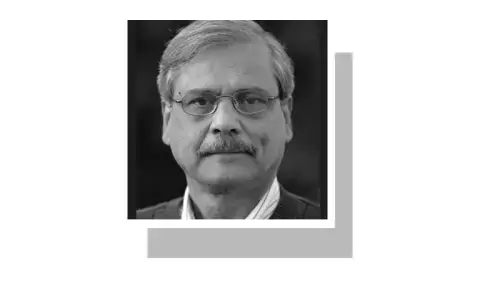
The writer is a former professor of economics at the Quaid-i-Azam University, Islamabad.