



 0
0

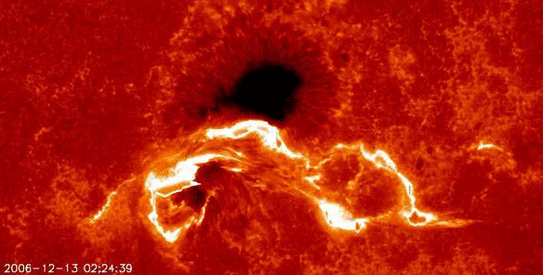
SINGAPORE: A cyclical drop in the sun’s radiation can trigger unusually cold winters in parts of North America and Europe, scientists say, a finding that could improve long-range forecasts and help countries prepare for blizzards.
Scientists have known for a long time that the sun has an 11-year cycle during which radiation measured by sunspots on the surface reaches a peak then falls. But pinning down a clear link to weather has proved harder.
“Our research confirms the observed link between solar variability and regional winter climate,” lead author Sarah Ineson of the UK Met Office told Reuters in an email. The study was published in the journal Nature Geoscience on Monday.
Her team focused on data from the recent solar minimum during 2008-10, a period of unusual calm for the sun and intense winters in the United States and parts of Europe that shut down air travel and disrupted businesses.
The researchers found that a reduction in ultraviolet (UV) radiation from the sun can affect high-altitude wind patterns in the Northern Hemisphere, triggering cold winters.
“While UV levels won’t tell us what the day-to-day weather will do, they provide the exciting prospect of improved forecasts for winter conditions for months and even years ahead.
These forecasts play an important role in long-term contingency planning,” Ineson, a climate scientist, said.
Ineson and colleagues from the Imperial College London and the University of Oxford used satellite data that more accurately measures UV radiation from the sun and found a much greater variability than previously thought.
They found that in years of low activity, unusually cold air forms high in the atmosphere over the tropics. This causes a redistribution of heat in the atmosphere, triggering easterly winds that bring freezing weather and snow storms to northern Europe and the United States and milder weather to Canada and the Mediterranean.
When solar UV radiation is stronger, the opposite occurs.
Ineson’s team used the data in a complex computer model that simulates long-term weather patterns. The model successfully reproduced what scientists have observed happening in the upper atmosphere during changes in solar radiation.
More study was needed, though. A key uncertainty in the experiment lay in the satellite data used, because it spans only a few years. “So questions remain concerning both accuracy and also applicability to other solar cycles,” she said.


























