0
0

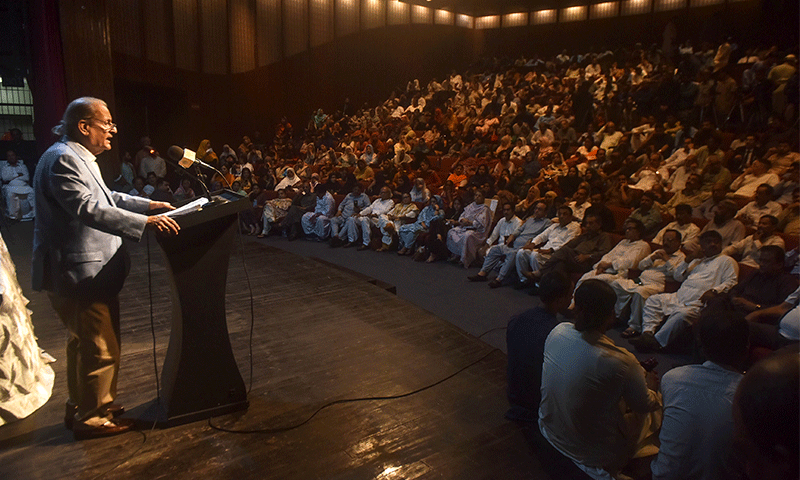
KARACHI, Nov 12: Speakers at a seminar on Tuesday demanded that the local councils system should be strengthened after the new governments were formed at the Centre and provinces.
Speaking at the seminar “Future of Local Bodies Institutions after the General Elections”, organized by the Pakistan Institute of Labour Education and Research (PILER), they stressed the need for a constitutional cover for the local councils system so that the future political governments could not scrap it.
They said that the local governments system differed in functions from the federal and provincial assemblies. The local councils ensured the provision of the civic amenities, whereas the assemblies formulated laws and policies.
The speakers claimed that in the past the military governments established the local bodies but the civilian governments used to discard them. The military governments usually set up the local bodies to counter the politicians, but the political governments considered them as their competitors and never encouraged the system.
MNA-elect Abdul Sattar Afghani, who had also served the city as a mayor for two four-year terms, said that from 1979 to 1985 there was no political interference but after getting the power the civilian government started mingling with the affairs of the local bodies.
Criticizing the abolition of octrai system by the Sharif-led government, Mr Afghani demanded that the system be reintroduced for it was a major source of income of the civic agencies. He also criticized the formation of 18 towns in the city.
Kaiser Bengali, an economist, suggested that the district governments needed full economic empowerment as at present the funds were released by the Centre to the provinces and then to the districts.
He was of the view that the economically unviable districts be merged with the neighbouring ones for smooth functioning.
He proposed that the local councils’ elections be held on proportional representation so that even the smallest section of the society get representation.
Arif Hassan of the Urban Resource Centre, urged the councillors to strengthen the system as it was for the first time that the bureaucracy was made subordinate to the public representatives.
He urged that the city council, the town councils and the union councils needed good working relations to make the system successful.
Baseer Naveed of the PILER said that the councils’ decisions be taken at the council level and the mayor be elected directly by the public.
He demanded that the police and bureaucracy be made subordinate to the local councils and politicians should be barred from interference.
City councillor Sadiq Rathore, in responce to an earlier speech, said that honorarium was already being given to the local council members in Punjab and here also a resolution demanding the payment of honorarium was passed and sent to the government and was hopeful of its acceptance.
Sharafat Ali, Mahmooda Banu, Mohammed Zubair, Dildar Ahmad Khokhar, and others also spoke.