0
0

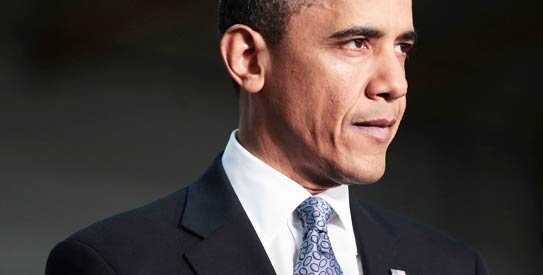
WASHINGTON: On the 10th anniversary of the US military campaign in Afghanistan, President Barack Obama told his nation that he was ending the Afghan war responsibly.
On Friday, the war in Afghanistan became America’s longest military engagement ever but most Americans were still debating what should be the best strategy for bringing that war to an end.
In a statement issued by his office, Mr Obama pledged to implement his plans for turning over Afghanistan’s security to the Afghans themselves by 2014. “After a difficult decade, we are responsibly ending today’s wars from a position of strength,” Mr Obama said. “As the rest of our troops come home from Iraq this year, we have begun to draw down our forces in Afghanistan and transition security to the Afghan people, with whom we will forge an enduring partnership,” he said.
Mr Obama largely avoided the controversy surrounding the war, but he did refer to “the enormous challenges that remain in Afghanistan”.
He praised the US military effort that began shortly after the 9/11 attacks. “Thanks to the extraordinary service of these Americans, our citizens are safer and our nation is more secure,” he said.
“In delivering justice to Osama bin Laden and many other Al Qaeda leaders, we are closer than ever to defeating Al Qaeda and its murderous network,” he added.
Meanwhile, Defence Secretary Leon Panetta said the US and its Nato allies would meet in Chicago next May to decide how many troops to keep in Afghanistan after 2014.
“There is a real commitment by all … to a long-term enduring relationship with Afghanistan and with the Afghan people,” he said.
“We remain unified in the goal of achieving a stable Afghanistan that can govern and secure itself for the future.” Although Mr Obama avoided making any new commitment, his likely rival for the 2012 presidential election, Mitt Romney, said he wanted US troops to stay in Afghanistan for as long as it took to complete the mission.
“I will order a full review of our transition to the Afghan military to secure that nation’s sovereignty from the tyranny of the Taliban,” he told a debate on Thursday night.
“I will speak with our generals in the field, and receive the best recommendation of our military commanders. The force level necessary to secure our gains and complete our mission successfully is a decision I will make free from politics,” he said.
Mr Romney’s response echoed at the White House press briefing on Friday where Press Secretary Jay Carney said there was no need to redo the US war strategy as Mr Obama’s policy was “excellent”.
But Stanley McChrystal, the former commander of coalition forces in Afghanistan, warned that Nato was “a little better” than halfway to achieving its military goals.
Gen McChrystal also acknowledged that that United States had a “frighteningly simplistic” understanding of Afghan culture and society when it launched the war.
He said the biggest problem facing the US would be to “create a stable, legitimate Afghan government that can serve as a counterbalance to the Taliban”.
“Americans are learning a history lesson: Getting into Afghanistan is much easier than getting out,” comments The Los Angeles Times while reflecting on these conflicting statements. So far 1,801 US troops have been killed in Afghanistan while thousands have been wounded. The Americans also have spent more than $1.28 trillion so far. Afghan deaths were not reliably counted in the first years of the war. But the UN says 11,221 civilians have been killed since 2006, 1,462 of them in the first six months of this year. The costs — both in lives and dollars — are influencing the public opinion as well. A recent CBS News poll found that nearly 6 in 10 Americans say the United States should not be involved in Afghanistan, a sharp turnaround from as recently as two years ago, when a majority supported the US mission there. Almost 7 in 10 people say the war has gone on longer than they expected.
A recent Pew Research opinion poll suggests that one in three US veterans of the post-9/11 military believes the wars in Iraq and Afghanistan were not worth fighting, and a majority think that after 10 years of combat America should be focusing more on its own problems.
Another Washington Post-Pew Research Centre poll finds a 44 per cent plurality of Americans support for Obama’s plan to withdraw combat troops from Afghanistan by 2014. Roughly three in 10 say he is not withdrawing quickly enough and 14 per cent say he is moving too quickly.