0
0

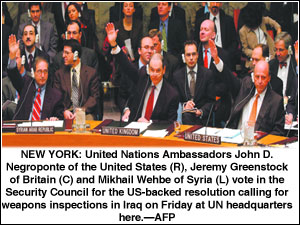 UNITED NATIONS, Nov 8: The United Nations Security Council on Friday unanimously adopted a tough new US-British sponsored resolution giving Iraq one last chance to eliminate its weapons of mass destruction or face ‘serious consequences’, and ordering President Saddam Hussein to accept its terms within a week.
The surprise unanimous vote (15-0) came on Friday morning after the US agreed to a compromise, wherein it agreed to come back to the Security Council before embarking on any military action.
France, Russia, China and Syria who had expressed serious reservations about the original US resolution which automatically triggered a war, seemed somewhat satisfied with the new language in the resolution which obligates the US and its allies to come back to the council for further action if Iraq fails to comply with any conditions set in the resolution.
The operative clause (12) specifically reads “Decides to convene immediately upon receipt of a report in accordance with paragraphs 4 or 11 above, in order to consider the situation and the need for full compliance with all of the relevant council resolutions in order to secure international peace and security.”
However, the vote which came after eight weeks of arduous negotiations, was seen as a victory for the United States, which drafted the resolution together with Britain.
“This resolution is designed to test Iraq’s intentions,” US Ambassador to the UN, John Negroponte, said in remarks after the vote.
Negroponte said the resolution gives international inspectors broad authority to look for Iraq’s weapons of mass destruction — to check ‘anyone, anywhere, anytime.’
However, he pointed out that there were “no hidden triggers” for the automatic use of force against Iraq if it did not comply with the resolution. Negroponte said that should the inspectors report Iraqi violations, the matter would return to the Security Council.
The resolution, he said, is “a new powerful mandate” for the weapons inspectors.
“The broad support sends a strong message to Baghdad that the Security Council — divided for years over Iraq — expects full compliance with all UN resolutions,” one diplomat said.
Iraqi Ambassador to the United Nations Mohammed Aldouri reacting to the adoption of the resolution, said that the resolution “creates demands that will be hard for Iraq to meet.”
“This is the will of the United States on the rest of the world,” Aldouri told reporters.
“I am very pessimistic. This resolution is drafted in such a way to prevent inspectors to return to Iraq,” he said.
However, Aldouri did not say whether Baghdad would accept the resolution.
“We will wait and see what the reaction is from Baghdad,” Aldouri said.
“Others did their best, they did what they could — France, Russia, Syria and China — and in the end they had to look after their own national interest,” Aldouri said.
The UN Secretary-General, Kofi Annan, said in a statement “Iraq has a new opportunity to comply with all these relevant resolutions of the Security Council. I urge the Iraqi leadership for the sake of its own people...to seize this opportunity and thereby begin to end the isolation and suffering of the Iraqi people.”
A breakthrough in negotiations came on Thursday when France and the United States reached a critical agreement to address French concerns that the resolution could automatically trigger an attack on Iraq.
“This resolution does not constrain any member state from acting to defend itself from the threat posed by Iraq ... to the government of Iraq our message is simple: non-compliance is no longer an option,” the US ambassador said.
Iraq has to confirm within seven days of adoption of the resolution its intention to “comply fully” with its demands and cooperate with UN weapons inspectors.