0
0

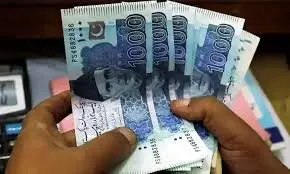
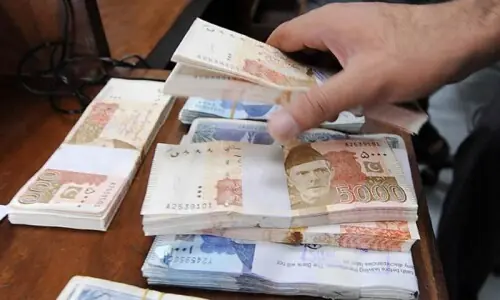
FAT fuel oil import bills and external debt repayments peeled 1.2 per cent off the rupee value against the dollar during the week ending May 20.
The dollar closed at Rs86.18 in interbank market with a record weekly gain of Rs1.06 per unit forcing the rupee to shed some of the gains it had made in recent months on record growth in export earnings and home remittances.
Senior bankers said an estimated $250m-$300m went out of the system on fuel oil payments, adding that the release of choked government funds to oil marketing companies had accelerated clearance of delayed oil import bills. This was in addition to an unidentified but large amount of foreign exchange spent on external debt payments.
“The rupee lost 55 paisa to the dollar on a single day on May 20 after one major bank had dished out $40 million for a defence-related payment,” said an official of Financial Market Association—a caucus of treasury officials of local and foreign banks. Another official of FMA also confirmed it. But both had no idea of the nature of the transaction.
Some bankers said the central bank made no significant dollar buying from banks during the week under review breaking of more than a month-long spell of its intervention in the forex market. In earlier weeks the central bank had been buying dollars to build up forex reserves and prepare for end-June external debt payments.
“But I think the most essential purpose of dollar buying—if you so like to call it—was that we wanted to keep the rupee from rising to new artificial highs,” explained a senior official of State Bank of Pakistan.
“If you look at overall exchange rate movement so far this fiscal year (between July 1, 2010 and May 20, 2011) you'd find the rupee has lost less than 0.8 per cent of its value vis-Ã -vis the US currency,” he pointed out.
Without naming the IMF he said: “international economists have been arguing with us that even at this level the rupee is slightly over-valued.”
An official of the Ministry of Finance, however, confided to Dawn that the IMF “had some reservations about the strength the rupee showed in recent months”.
Meanwhile, Pakistan's foreign exchange reserves eased to $16.97 billion as on May 14 from $17.01 billion a week earlier as the country braced for end-June external debt payments. The reserves had maintained upwards of $17 billion levels for several consecutive weeks—thanks to unusually large inflows of export and home remittances' dollars.
Senior bankers said the interbank market was still getting enough foreign exchange in the shape of export earnings and remittances sent back home by overseas Pakistanis. “And I don't think the rupee would see any significant loss in coming weeks,” said treasurer of a large local bank.
“Whatever stripping (of the rupee value) we saw lately was because the central bank was smoothening exchange rate movements.
That is it. Otherwise our current account surplus is growing and our balance of payments is OK. We ought not to speculate against the rupee.”
During the week to May 20 the government borrowed Rs147 billion from banks, corporates and individuals of high net worth through sale of about Rs159 billion worth of T-bills. And it had to increase the returns on the bills to lift this amount from a modestly liquid money market. But bankers pointed out that the hiking of T-bills rates was a mere reversal of the decrease in the rates recorded in previous auction.
The cut-off yields on three-month and six-month bills were hiked up by 14 and 11 basis points to 13.20 per cent and 13.59 per cent respectively. And 12-month yield reached 13.84 per cent with a nominal increase of five basis points.
Benchmark interest rates only partly reflected this trend. Whereas the benchmark six-month KIBOR went up 13 basis points to 13.69 per cent, one-year KIBOR showed a negligible rise of two basis points and three-year KIBOR remained unchanged.
Recently the government has been borrowing excessively from banks to fill in the gap between its budgetary income and expenses. As a result the stock of government borrowing is growing.
Federal government's net borrowing from banks in over ten months (up to May 7) stood around Rs397 billion—up 96 per cent from its borrowings in the year-ago period. That has crowed out the private sector whose bank borrowing fell to Rs113 billion from Rs131 billion.