0
0

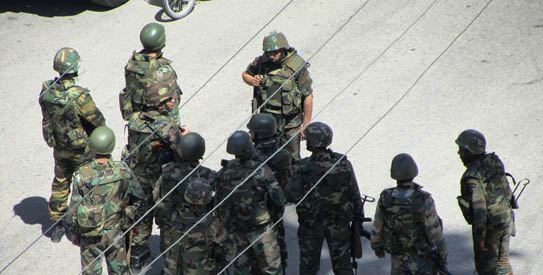
DAMASCUS: Regime opponents took to the streets Friday for rallies which Syria's President Bashar al-Assad ordered troops not to fire on, even as his forces mounted a sweeping arrest campaign in protest hotspots.
Soldiers and security services deployed in a massive show of force for the rallies, as demonstrators emerged from mosques in the Kurdish majority northeastern city of Qamishli, activists said.
"Around 3,000 people have started to march from Qasmo mosque in Qamishli" after the main weekly Muslim prayers, one activist told AFP.
Louai Hussein, a writer and leading activist, said earlier the protests would go ahead as usual following Friday's prayers, after Assad's office promised him security forces would not shoot at demonstrators.
In a message posted on his Facebook page, Hussein said that senior Assad adviser Bouthaina Shaaban had "told me during a telephone conversation that strict presidential orders were given not to fire on the demonstrators." "All of those who violate these orders will assume full responsibility," he quoted Shaaban as saying.
The activist went on to call for "peaceful protests, regardless of the behaviour of the security services." Shaaban announced meanwhile that the regime planned to start "a national dialogue" on topics including political pluralism, elections and the media next week with Hussein and other activists, according to Al-Watan, a privately-owned daily close to the regime.
The Syrian Revolution 2011, a Facebook group that has been a driving force behind the protests, has called for a "Free Women Friday" in support of arrested women demonstrators.
Four women were killed during protests on May 7 and several have been arrested, particularly in Damascus and the Mediterranean coastal city of Banias, where they marched calling for the release of detained relatives, activists said.
Russia cautioned earlier against foreign intervention in Syria that could repeat the "Libya scenario," after the United States warned Assad's regime would face more international pressure over its bloody crackdown on protests.
Syria, one of the most autocratic countries in the Middle East, has been rocked by two months of unprecedented popular protests inspired by revolts that ousted strongmen in Tunisia and Egypt.
Up to 850 people have been killed and at least 8,000 arrested since the protest movement emerged in mid-March, human rights groups say.
The regime has routinely blamed the deadly violence on "armed terrorist gangs." On Thursday, troops and security agents pressed on with the crackdown, rounding up opposition leaders, rights watchdogs said.
The Syrian Observatory for Human Rights said dozens of people were detained in Banias and the neighbouring villages of Al-Beyda and Al-Qariri.
Lawyer Jalal Kindo was among those held in the city, where security forces have been hunting down dissidents and protest organisers, the London-based group said.
Prominent rights campaigner Najati Tayara was picked up in Homs, his rights group said, a day after he reported shelling and gunfire in the central industrial city that has been the focus of a massive military operation since Monday.
Activists, journalists, and intellectuals were also detained in Damascus and the cities of Aleppo and Latakia, as well as smaller protest centres.
US Secretary of State Hillary Clinton warned Syria on Thursday it will face more international pressure over its crackdown on popular protests, behaviour she called "a sign of remarkable weakness." But Russian Foreign Minister Sergei Lavrov cautioned Friday against foreign intervention in Syria, and urged the opposition not to seek a repeat of the "Libya scenario" where Western allies are carrying out air strikes against regime targets.
The office of UN human rights chief Navi Pillay said meanwhile it was extremely worried about reports that up to 850 people have been killed in the protests, calling on the regime to halt its bid to "silence opponents". "NGO (non-governmental organisation) reports are suggesting that somewhere between 700 and 850 people have been killed since the start of the protests on March 15 and thousands have reportedly been arrested," the spokesman, Rupert Colville, said.
"These are extremely worrying reports and we urge the government to exercise restraint again, to cease the use of force and the mass arrests being used to silence opponents," he added. Colville said the UN had been unable to verify the numbers but noted they were backed by detailed lists.
"We don't believe the numbers are unlikely," he told journalists.