0
0

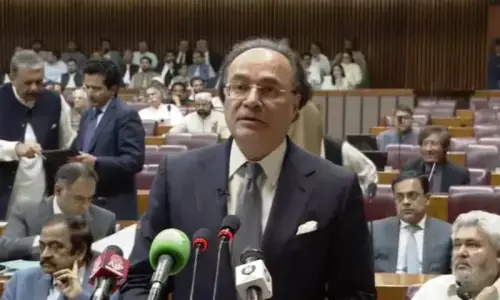
KARACHI, Oct 14: “We will pursue policies that would bring investment and reverse the flight of capital,” says MMA leader Qazi Hussain Ahmad.
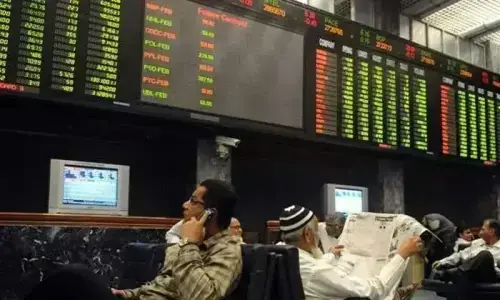
He was responding to the reaction of investors who feared that the victory of religious parties would impact on foreign capital inflows.
If the alliance is sustained by the emerging politics of consensus in the ranks of the religious parties, they can gradually bring sectarianism to an end. Sectarian clashes have been partially responsible for the law and order situation. And one of the important factors for low level of investment can be explained in the context of security concerns.
By coming into parliament, the religious parties may tend to join the political mainstream, rather than allowing its militants to confront each other on the streets.
With fast changes, one is often stuck up with conventional wisdom. The political labels stick for a long time, with realities undergoing a change. The PPP’s socialism under Zulfiqar Ali Bhutto evaporated under the tenure of his daughter Benazir Bhutto. Sooner or later, ideas, concepts and leaders change with times.
The surprise victory of the MMA has not given investors the time to ponder and digest the real message of the MMA voters. The MMA’s victory is Pakhtoons’ ethnic reassertion as well as that of Pakistani and Muslim nationalism. It translates into provincial and fiscal autonomy and federalism, and in the exercise of sovereign rights in the conduct of foreign affairs and in dealing with donors and promoting cooperation with Muslim states.
The opposition to the country’s Afghan policy has energized the Pakhtoons to vote for the anti-US religious parties. The Pakhtoon nationalists lost because they sought solutions under the umbrella of superpower politics.
The MMA did not win the elections purely on the basis of a programme that was Sharia-compliant. It is nationalism, a vital aspect of democracy, that has diluted their sole focus on their religious programme. This is evident from the characterization of the MMA as an alliance of political moderates. The modernization of the economy achieved so far tends to make politics secular, inculcates pluralism and strengthens sovereignty.
The message of the voters in the NWFP and Balochistan was loud and clear. They are against the US invasion of Afghanistan and the west’s cultural invasion of Pakistan.
If the MMA sticks to its programme, it has to help evolve an independent path of economic and social development. In the field of economics, it is rejection of the dependency school of thought and a clarion call for the development of a self-reliant national economy. Although winning 45 out of 272 seats, the MMA is also aware of the limits of its political power. And the Amir of Jamaat-e-Islami Qazi Hussain Ahmed says that the MMA would take along all parties within and outside parliament in taking decisions and all the component parties of the alliance would have to follow the decisions. The MMA is moving towards the politics of consensus and, which, in days to come, may help religious parties to modernize their outlook. What often is seen in individual cases may begin to take shape in organizations. Of course, the MMA is not expected to abandon its religious outlook altogether.
For all this to happen, the MMA has to respect the people’s verdict at the polls. That the alliance should not split and work to carry out the voters’ mandate, can only be possible through politics of consensus. It is their performance in the NWFP that would make or mar their future for which they also need to further modernize their social outlook. It has to be a voluntary evolution. It should not be forgotten that the unity of religious parties and the MMA’s victory are also a backlash against official steps to combat militants in the ranks of some of them.