0
0

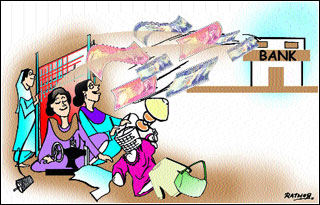 Presently, in its wider dimension micro-credit is known as micro-finance and seen as a legitimate economic tool in the fight against poverty. It is very difficult for the poor to get small working capital from formal banking system for various reasons.
A collateral-free working capital loan,at the doorsteps of the poor at the right time to help them facilitate and start feasible intended income generating activities, is the primary requirement. It is with this background that micro-finance is seen as one of the significant approaches to poverty alleviation.
The micro-credit programme (MCP) in Pakistan is women-client-based. As rural women have a higher propensity to save and a habit of repaying credit in time than rural men, MCP have found a dependable client-base in rural poor women.
Interventions: Like many other developing countries, the GOP has undertaken a wide-range of programmes spreading across sectors and ministries to create wage as well as self-employment opportunities, created separate ministry for women and changed strategies and policies in favour of development of women.
A large number of NGOs are also involved in creating employment opportunities through the provision of collateral-free micro-credit to the poor. Many NGOs were formed immediately in post-liberation war period for rehabilitation of war victims. Later on, they moved towards self-reliant development through a process of empowering women. With the success of Grameen Bank’s in Bangladesh, large number of NGOs in Pakistan introduced MCP for their members. Although NGOs replicate the Grameen model in general for MCP, many have introduced some innovative variations on the basic structure i.e., in terms and conditions of products, and in methods of implementation.
Impact: When we talk about the impact assessment of women’s participation in MCP two different but closely linked types of changes are expected:
Conditional change: It is essentially welfare-based focusing on increased health, education or livelihood provisions for women in order to improve their immediate circumstances.
POSITIONAL CHANGE: It occurs when women are able to increase their decision-making role, and to take control over key aspects of their lives, i.e. they have increased power.
Participation: A rapid impact assessment study was conducted by the World Bank/IDA with a view to monitoring and assessing the impacts of MCPs. It had found micro-credit in rural areas as one of the major factors for upgrading the status of women both in the family and the community and pointed towards an overall positive direction. Women’s social position in community is evaluated through three indicators:
EMPLOYMENT: Women have very limited opportunities for employment and face strong supply barriers as well. Self-employment is slightly more common than wage employment and generate more days of employment for all categories of households.
But these do not help to dispense with or reduce the existing workload of women in the family like cooking food, nursing babies, sending children to schools, taking care of other members of family, washing cloth, cleaning house, attending poultry birds and livestock, and backyard vegetable garden. The credit programme bring additional work for women even though sharing of responsibilities by other members of the family takes place to some extent.
Mobility: It has a major implication in matters of employment, social awareness, confidence-building and increasing status of relative position in the community. Generally, the restriction on women’s mobility is positively related to the degree of male dominance of the public space.
By 2000, there has been a tremendous increase in the extent of women’s mobility in all household groups, especially with respect to visits to the most male-dominated public space. The extent of mobility, however, varies from household to household. In the study it is found 30 per cent to 70 per cent women had visited health centres, police stations, district headquarters and parents’ houses. This mobility has encouraged non-programme women also to increase their mobility.
Hence, participation has a large positive effect in expanding women’s sphere of movement outside the home leading to an improvement in their position in the community. This is quite significant in the context of rigid rural social environment of Pakistan.
Birth control measure: During the last two decades small family norm has gained widespread credibility and contraceptive use had become widely acceptable as legitimate behaviour. The incidence of using contraceptive is significantly higher among the MCP participants than the non-participants. Through demonstration effect non-programme households have picked up the use of birth control methods.
Intra-household position: Another aspect of women’s empowerment is the relative position of women within the household through the following process indicators:
Household income control: Income inequality persists in rural household processes like access to, and control over, household budget (income and expenditure). It is found that women have relatively lesser control on income and expenditure decisions, particularly with regard to income generated by males outside the households. There is significant channelling of funds borrowed by females to support male activities.
Impact studies found that women are gaining greater say in income and expenditure decisions to the extent of 25 to 30 per cent of households. Programme women’s participation has increased in expenditure decisions relating to poultry rearing, schooling of children and health care.
Fertility regulation: Fertility regulation is seen as the responsibility of women. Since women are expected to bear all the cost of using contraceptives fertility regulation is a highly inequitable household process. Therefore, the degree of gender equality in fertility regulation is reflected by the extent of husband’s responsibility for regulating fertility. The study shows that increase in the use of male methods was greater among continuous programme participant households.
PERCEPTION: Programme women’s perception about their status in the family, relationship with husband and self-esteem are good subjective indicators of perception. The study shows borrower’s perception about the extent of improvements through their involvement in micro-credit programme as follows:
* all aspects of life: 37.6
per cent;
* relationship with
husbands: 38 per cent;
* Self-esteem: 44 per cent;
Improvement in self-esteem was the highest followed closely by relationship with their husbands and all aspects of life. In matter of improvement in all aspects of life the study took cognizance about opportunities to enhance income, acquire self-reliance, ‘improve health and sanitation and facilitate education of children etc of the MCP participants.
Expectations: Violence against women and dowry demands are still the curse in the society. But there was no evidence of casualty between violence and micro-credit programme.
However, income from micro-credit or the credit itself may have been used in paying dowry. Through social awareness exercised in-group meetings, dowry and other social violence of rapes, acid throwing can be addressed.
With this in view, practice of male spouse’s participation in group meetings occasionally to discuss social awareness building issues, sure would help to mitigate social unrest to some extent.
It is expected that women should be out of the poverty trap, reduce credit dependency, combat the risks on non-repayment due to shock or disaster when income and consumption for them decline suddenly.
At the other end many programme women are moving up the scale and their need for credit fund is increasing. Real challenge for the future of women MCPs lies in meeting the need for innovation and diversification in delivery method and introduction of new MCP products.
CONCLUSIONS: Manifold problems of women cannot be overcome only by small grants and credit support. A package programme consisting of leadership and managerial development, of rights and laws, of education, credit, income, health and reproductive issues seems to be appropriate for removing these problems and for stepping up women’s position in the society.