0
0

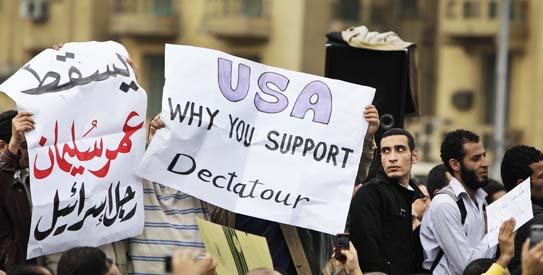
WASHINGTON: The man named by President Hosni Mubarak as his first ever deputy, Egyptian spy chief Omar Suleiman, reportedly orchestrated the brutal interrogation of terror suspects abducted by the CIA in a secret program condemned by rights groups.
His role in the shadows of the “war on terror” illustrates the ties that bind the United States and the Egyptian regime, as an unprecedented wave of protests against Mubarak present Washington with a difficult dilemma.
With Mubarak’s rule in jeopardy, Suleiman was anointed vice president last week and is now offering wide ranging talks with the opposition in a bid to defuse the crisis.
Suleiman is a sophisticated operator who carried out sensitive truce negotiations with Israel and the Palestinians as well as talks among rival Palestinian factions, winning the praise of American diplomats.
For US intelligence officials, he has been a trusted partner willing to go after Islamist militants without hesitation, targeting homegrown radical groups after they carried out a string of attacks on foreigners.
A product of the US-Egyptian relationship, Suleiman underwent training in the 1980s at the John F. Kennedy Special Warfare School and Center at Fort Bragg in North Carolina.
As spy chief, Suleiman reportedly embraced the CIA’s controversial “extraordinary rendition” program under ex-president George W. Bush, in which terror suspects snatched by the Americans were taken to Egypt and other countries without legal proceedings and subjected to harsh interrogations.
He “was the CIA’s point man in Egypt for rendition,” Jane Mayer, author of “The Dark Side,” wrote on the New Yorker’s website.
After taking over as spy director, Suleiman oversaw an agreement with the United States in 1995 — during Bill Clinton’s presidency — that allowed suspected militants to be secretly transferred to Egypt for questioning.
Human rights groups charge the detainees have often faced torture and mistreatment in Egypt and elsewhere, accusing the US government of violating its own legal obligations by handing over suspects to regimes known for abuse.
In the run-up to the US invasion of Iraq in 2003, the CIA relied on Suleiman to accept the transfer of a detainee known as Ibn Sheikh al-Libi, who US officials hoped could prove a link between Iraq's Saddam Hussein and Al-Qaeda.
The suspect was bound and blindfolded and flown to Cairo, where the CIA believed their longtime ally Suleiman would ensure a successful interrogation, according to “The One Percent Doctrine” by author Ron Suskind.
A US Senate report in 2006 describes how the detainee was locked in a cage for hours and beaten, with Egyptian authorities pushing him to confirm alleged connections between Al-Qaeda and Saddam.
Libi eventually told his interrogators that the then Iraqi regime was moving to provide Al-Qaeda with biological and chemical weapons.
When the then US secretary of state Colin Powell made the case for war before the United Nations, he referred to details of Libi'’s confession.
The detainee eventually recanted his confession.
In “Ghost Plane,” a book about the rendition program, journalist Stephen Grey writes that Egypt faced regular public criticism from lawmakers in Congress about its rights record.
“But in secret, men like Omar Suleiman, the country’s most powerful spy and secret policeman, did our work, the sort of work that Western countries have no appetite to do themselves,” he wrote.