



 0
0

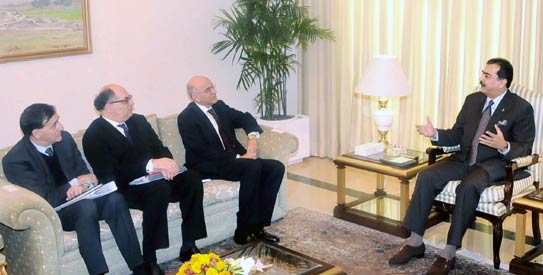
ISLAMABAD: Prime Minister Syed Yusuf Raza Gilani has said the government is committed to economic reforms and is also evolving political consensus on resource mobilization besides chalking out a long-term national economic strategy.
The Prime Minister was talking to a three-member IMF delegation led by Masood Ahmed, Director IMF for Middle East and Central Asia, here at the PM House on Monday.
He reiterated that the Government was pursuing a long term structural reform programme to put Pakistan on a trajectory of sustainable economic growth and development.
He highlighted the positive trend in the national economy as a result of steps taken by his government like substantial increase in exports, record remittances and all time high foreign exchange reserves, which he said, were reflective of the sound economic fundamentals of the country.
The Prime Minister underlined that despite Pakistan's current economic difficulties, his government will remain steadfast in its commitment to introduce and implement reforms.
In this connection, he added, the Government team is meeting the opposition to evolve political consensus on resource mobilization and long term national economic strategy.
Referring to the progress of the Government's economic reforms agenda, the Prime Minister said the RGST (Reformed General Sales Tax) had already been introduced and passed through the Senate and intensive consultations were now being held with the major political parties of the country to build national consensus for their passage through the National Assembly.
He said the State Bank Amendment Bill has been passed while Banking Companies Ordinance is now under consideration of the National Assembly.
The Prime Minister said that the Government is restructuring the public sector corporations to transform the loss earning enterprises into a viable and profit earning entities which will also help cut down expenditure on subsidy to these corporations.
He mentioned that the Government had achieved macroeconomic stability despite the global recession and war on terror but the devastating floods have compounded the economic difficulties.
He pointed out that Pakistan is single-handedly catering to the needs of 3.5 million Afghan refugees without any help from the international community.
The Prime Minister urged the Friends of Pakistan to honour their commitments, adding, the flood affectees couldn't be made to wait for their early rehabilitation.
He said that as far as the government of Pakistan was concerned, it had already drastically cut its development and non- development expenditures to divert the resources for providing relief to the flood victims.
The Prime Minister said that after enactment of 18th Constitutional Amendment, the provincial governments' role in financial discipline has increased many folds.
He further said that while the government of Pakistan was implementing the economic reform programme in the interest of the country, the IMF should continue to help Pakistan to overcome economic challenges.
Masood Ahmed, Director IMF for Middle East and Central Asia said that the IMF supports Pakistan's direction to bring in financial discipline.
He thanked the Prime Minister for his time and appreciated his resolve to implement economic reform agenda.
The meeting was also attended by Minister for Finance, Dr. Abdul Hafeez Sheikh, Minister of State Hina Rabbani Khar, Governor State Bank, Shahid H. Kardar, Deputy Chairman Planning Commission, Dr. Nadeem ul Haq, Assistant Director IMF, Adnan Mazaeri, Senior Resident Representative IMF in Pakistan, Paul Ross, Secretary and the Chairman Federal Board of Revenue (FBR). – APP



























