0
0

JEDDA: Saudi Arabia yesterday became a constitutional monarchy by virtue of a proclamation published by King Saud. This revolutionary measure followed the king’s takeover as premier last week from his brother Crown Prince Emir Faisal.
Announcing the policy of King Saud’s new government, Radio Mecca said yesterday that it included the formation of a Constituent Assembly which would be granted one year to draft a constitution for the kingdom.
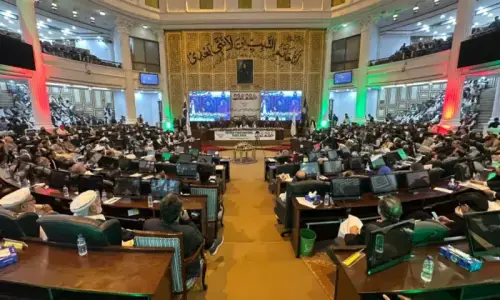
The Royal proclamation, however, announced the immediate coming into effect of a 200-article Constitution providing for the setting up of a National Assembly and other institutions, with a government responsible to the Assembly. Under this Constitution, the king, who will be the constitutional sovereign, will take the oath before the Assembly and rule through his cabinet.
The first article of the new Constitution states: “Saudi Arabia is an Islamic sovereign Arab state within the great Arab nation, with an indivisible territory and a regime which is that of a constitutional monarchy.”
The Constitution proclaims Islam as the state’s religion, and declares that the Islamic law is the fundamental source of the country’s legislation. The Arab language is proclaimed the official language of the kingdom.
The successor to the throne should be selected from the family of the late King Ibn Saud, father of the present king. A special constitutional provision would be issued later to regulate the succession in detail, according to the Constitution’s Article 4.
The king will, as in constitutional monarchies, name and dismiss ministers at the proposal of the premier. If the cabinet fails to win a vote of confidence in the Assembly, it will have to hand its resignation to the king.
The National Assembly, which will meet in the capital Riyadh, will be composed of minimum of 90 and maximum of 120 members, two-third elected and one-third named by a special 10-member committee. This committee will also rule on the eligibility to parliament of Saudi Arabian citizens aged over 25 years.
The appointed members of the Assembly will be picked by the committee from the royal family and from amongst religious dignitaries, tribal chiefs, land-owners, bankers, businessmen and other categories of the population, including trade union leaders.