0
0

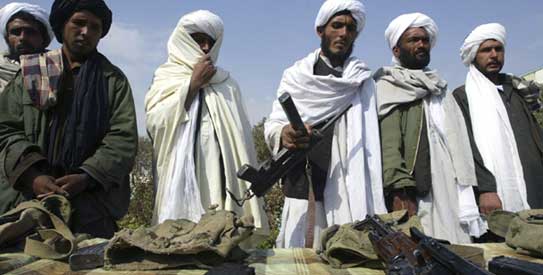
KABUL: Scribbled notes from Taliban leader Mullah Mohammad Omar have surfaced in mosques all over Afghanistan’s Pakhtun heartland, threatening death to anyone who takes up a government offer to negotiate for peace, according to a long-time Taliban member.
Trying to quash rumours of a break in their ranks, the Taliban also have vehemently denied news reports that representatives of the militant group were involved in negotiations with the Afghan government.
The leadership could be worried that commanders might strike separate deals that would threaten to undermine the militancy and cripple the morale of their rank-and-file fighters.
President Hamid Karzai has made reconciliation a top priority and recently formed a 70-member High Peace Council to find a political solution to the ongoing conflict. At the same time, the US-led coalition has ramped up its military campaign in an effort to pound Taliban commanders to the negotiating table.
There are no signs that either strategy is having much effect on the senior Taliban leadership.
A veteran Taliban member who reportedly visited the powerful Shura, or council, in Quetta controlled by Mullah Omar said there was no talk of negotiation among those who controlled the militancy.
“None of the big Taliban is talking,” the bulky, bearded Taliban member said on condition of anonymity for fear of reprisal from both the government and the religious movement. “I have been to Quetta and I know the council there is not talking.”
In an interview, he said the handwritten scribbled notes started appearing in mosques shortly after news of Mr Karzai’s peace overture was broadcast around the country. In the past, Mullah Omar has used notes and sometimes audio recordings to get his message across.
“We heard it on the radio,” the Taliban member said of President Karzai’s overture and reports of contacts between the Taliban and the government. “No one in our village has televisions,” explained the man, who has played an integral role in the Taliban for the past 15 years and has been interviewed numerous times since the 1990s.
“The Taliban don’t allow televisions.” During Taliban rule, television was banned. Even if the top Taliban leadership did not participate, a number of exploratory talks have taken place with the militants over the past two years, according to lawmakers, peace council delegates and former and current members of the Taliban.
The talks were held in various places, including Saudi Arabia, the United Arab Emirates and Afghanistan, said Habibullah Fauzi, a peace council member who once served as the Taliban’s ambassador to Saudi Arabia.
According to peace council members, those who have held talks with government officials include Maulvi Abdul Kabir, the former Taliban governor of Nangarhar province; Aga Jan Mohtasim, a former Taliban finance minister and current member of the Taliban council in North Waziristan area; Maulvi Akhtar Mansoor, a former Taliban minister of civil aviation; Qudratullah Jamal, a former Taliban information minister; and Tayyab Agha, a special assistant to Mullah Omar.
One member of parliament said that he personally met Mohtasim four times. “These are not official negotiations. They are Taliban meeting people they trust to try to know what the government and the international community is thinking,” said the parliamentarian, who declined to be identified because it would compromise his relationship with the Taliban.
The AP has previously reported that Kabir and two other midlevel Taliban leaders met Mr Karzai in mid-October to discuss the Haqqani network, an Al Qaeda-linked group that controls much of eastern Afghanistan.
A former Afghan official said the discussion did not focus on the peace effort, but rather on weakening the Haqqani network’s influence in eastern Afghanistan by dividing tribal loyalties between its leader and Kabir.
The Taliban and President Karzai’s spokesman Waheed Omar both contested the report, saying the meeting never took place.—AP