0
0

BAGHDAD: Before the 2003 US-led invasion, Iraq's Al-Shaheed State Company used to make a blast, literally. Now it helps to produce music. “We used to make mortar shell casings, but our engineers changed the production line, so we now make brass for trumpets and vases, and copper cables,” said Amine Hawas, a company technician.
Al-Shaheed's fate has been mirrored by a string of other companies created during the regime of deposed dictator Saddam Hussein and since transformed under an order of the post-invasion government of US diplomat Paul Bremer to turn military industries into civilian ones.
Created in 1982, the reformed company displayed its wares at a four-day fair of state-owned industries in Baghdad this week.
Other companies at the exhibition have gone from making guns, bombs and military binoculars to water sprinklers, microscopes and bomb-disposal robots.
“After the American invasion, our factory was plundered and the ministry that supervised us dissolved. Our personnel were completely disoriented,” said Haidar Hussein, a 34-year-old engineer at the Al-Karama company stand.
Pre-war, the company in the northern Waziriyah district of the capital produced guidance systems for long-range missiles, and was visited by UN disarmament inspectors in 1998, when Iraq suffered under sanctions following its 1990 invasion of neighbouring Kuwait.
“A team of 10 engineers then started to become interested in the processes of simulation, scan and x-ray control,” said Hussein, explaining that personnel were retrained and the factory reopened in 2008, turning the page on its military past.
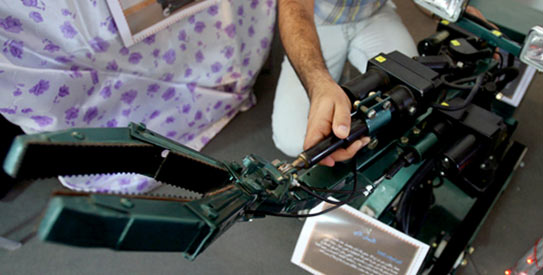
Now it is banking its fortunes on a bomb-disposal robot, proudly claiming that the machine, which left the factory only two months ago and was unveiled at the fair, was entirely made in Iraq.
“There is keen demand because of the (insurgent) attacks and because our product is much less expensive than that of the Americans,” Hussein said.
Before Saddam's fall there were 42 companies under the ministry of military industries, employing nearly 50,000 people.
But Bremer's Authority Order Number 75, issued in April 2004 a little more than a year after the invasion, commanded the “reconstitution of such companies for peaceful and resourceful uses.”Since then, all armament for Iraq's 800,000 soldiers and police has been bought abroad, particularly from the United States.
The Al-Ikhaa company, founded in 1984 when Iraq was mid-way into its eight-year war with Iraq, also made a successful turnaround from producing heavy artillery and military binoculars.
“We earned a lot of money at the time because armaments were a priority for Saddam Hussein, but later it was obviously necessary to seek other avenues” of income, said Amer Eid, a 50-year-old engineer at the company, which is based close to the Sunni-Muslim stronghold of Fallujah west of Baghdad.
Closed for several months after the invasion, the factory employing 3,800 people reopened in 2004 to produce filters, spare parts for cement factories, water-purifying machines, microscopes and, recently, gas butane cylinders.
“I believe that we are past our (financial) problems and will begin to make profits this year,” he said, hinting at the difficulties of the transition.
The Noaman company also made a spectacular turnaround, going from making cluster-bomb casings and ammunition to sprinkler pipes.
Salahaldin, established in 1980 under the supervision of French electronics giant Thomson and which made radars and military communications equipment and was even implicated in Iraq's nuclear programme until 1990, was also able to reinvent itself.
With 8.5 million dollars (six million euros) from the ministry of industry, the factory in Tikrit, north of Baghdad and the cradle of Saddam's tribal roots, now produces electricity poles, circuit-breakers and transformers.
Companies once accused of making chemical weapons now make fertilisers.
“Only the very specialised companies which manufactured guns, grenades or explosives did not make a successful reconversion,” said Eid.
Opening the fair on Monday, Industry Minister Fawzi Hariri said he wished to see “national industrial production increased, not to depend on imports.” But with industry accounting for only 10 percent of gross domestic product and oil contributing a sizeable 65 percent, Iraq still has a long way to go. – AFP