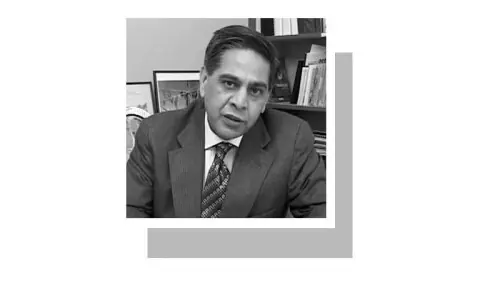
ASLAM Khwaja, one of the few comrades who have refused to lay down their arms after the demise of the Communist Party of Pakistan, is such a rebellious person that one cannot expect him to back a ruler.
But this is exactly what the bohemian guy is doing these days. He has even evolved a theory to defend his support for President Asif Ali Zardari. According to him, Zardari represents the civilian establishment which has regained power after a long time from the military establishment and for this reason the president deserves the support of democratic forces and civil society.
In fact Aslam Khwaja in his newly found love for Zardari represents the Sindhi intelligentsia and educated class. Since the Movement for Restoration of Democracy (1983) and even before that Sindh`s intellectuals and educated classes have been known for their ideological politics. Then why this metamorphosis? What factors have pushed this idealist Sindhi to pragmatism? Is it
pragmatism or wishful thinking? And finally, can Zardari prove to be the saviour of Sindh? These questions require honest soul-searching and critical analysis of the state of affairs in the province.
This change in political thinking of the province became visible when after the February elections a majority of Sindh`s lawyers began losing interest in the struggle for the independence of the judiciary and the reinstatement of the deposed chief justice of the Supreme Court, Justice Iftikhar Mohammad Chaudhry.
Earlier, lawyers from different cities of Sindh had been at the forefront of the struggle and, as acknowledged by one of the heroes of the lawyers` struggle, Chaudhry Aitzaz Ahsan, it was Justice Iftikhar Chaudhry`s visit to Sukkur and Hyderabad that instilled a new spirit in the nascent movement.
But after the Pakistan People`s Party came to power, lawyers of Sindh like other educated segments of society were haunted by the fear that the lawyers` agitation may lead to the toppling of the PPP government. As a result, many of the lawyers opted for absence from the lawyers` weekly protest, which lost its intensity and passion in cities like Hyderabad, Sukkur, Nawabshah and Mirpurkhas.
After Gen Pervez Musharraf departed from the President House and Zardari became its new occupant, most of Sindh`s lawyers lost whatever interest they had in the lawyers` movement. Defending this change, a Sukkur-based lawyer, who had earlier been very active, objected to the participation of the Pakistan Muslim League leader Mian Nawaz Sharif in the lawyers` rally in Lahore during their long march to Islamabad, and alleged that Justice Chaudhry is providing political mileage to the leader from Punjab. “In this situation, why should we become part of a move that can harm the first Sindhi president?” he asked.
Similarly, it seems that most of Sindh`s educated classes, including those who have sound political knowledge as well as experience, seem to be happy with the notion of a Sindhi president, forgetting that the presidency was the very institution the PPP and Benazir Bhutto had been fighting against. Moreover, they are forgetting that President Zardari and his PPP do not appear to be eager to come to Sindh`s rescue, a fact authenticated by the proposed privatisation of the Qadirpur gas field and the government`s silence over the digging of the controversial Kalabagh-Jhelum link canal.
The roots of this attitude lie in the suffering of rural Sindh during the Musharraf era and the hopelessness that has gripped it after the assassination of Benazir Bhutto. “Yes, it is this feeling of helplessness that has made Sindh`s people pin [their] hopes on Zardari,” says Dr Inayat Magsi, a political analyst. “But this can be very dangerous,” he adds, “it was the same feeling which made the Germans throw their weight behind Hitler.” He warns that Zardari can lead the Sindhi people to such an abyss from where there may be no escape.
Given Zardari`s style of running the PPP, his failure to deliver will lead to cracks in the party coupled with public disillusionment with it. If that happens, it will come as a blow to the morale of the Sindhis.
And perhaps the masses have already started feeling the bitter taste of disillusionment. According to an eyewitness, during one of Zardari`s late-night visits to his wife`s grave, when people were asked to vacate the mausoleum an elderly man retorted to the policemen “The man who is coming is, according to Islamic tradition, namehram (stranger) to BB and as such he is not allowed to visit her grave. Whereas we are sitting at the grave of our niyani (a respectful term for sister or daughter in Sindhi). So we are not going to leave this place. Force us out, if you like.”