0
0
NEW DELHI, Nov 7: Muttahida Qaumi Movement chief Altaf Hussain has said that President Gen Pervez Musharraf wants a lasting friendship with India and is working with sincerity to achieve that objective.
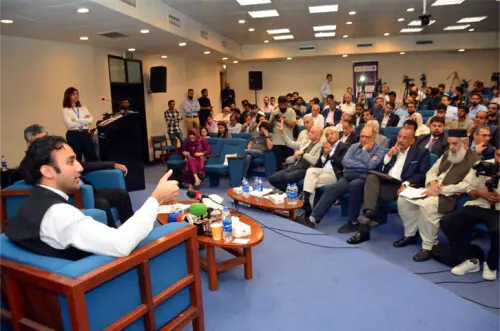
Addressing a press conference here on Sunday, he explained the benefits of his proposal for making the Line of Control a temporary border and said once the area was demilitarized and unnecessary interference ceased the stage would be set for talks on different issues.
Mr Hussain emphasized that wars, already used three times as an option, had failed to yield results.
Secondly, he said in the past India had close relations with the erstwhile Soviet Union. However, now it has more cordial relations with the United States than with Russia.
Answering a question about the MQM and its support for President Musharraf, Mr Hussain remarked that Musharraf despite being an army general had not imposed martial law and had held elections within three years of taking over. He was a man of liberal thinking and had taken a courageous stand on Kashmir.
Mr Hussain conceded that extending support to Gen Musharraf was a difficult decision. He said that dramatic change had taken place in the international situation after the 9/11 incident and religious extremist parties had arrayed themselves against him. "We in the MQM could never have sided with those thriving on extremism or on perverted logic because the country could have suffered immeasurably."
Besides, he said, the United States had left almost no option for Gen Musharraf on the day of the 9/11 attack. It was a "with us or against us" situation. The MQM being a liberal and prudent party opted to side with Gen Musharraf because it wanted the Kashmir issue to be resolved and peace and amity to replace tension and conflicts with India.
Replying to a question, he said the MQM was subjected to extra-judicial killings during the army operation in 1992, which continued even during the civilian regimes of Benazir Bhutto and Nawaz Sharif.
About his return to Pakistan from exile, he said that security was the biggest consideration. Even President Musharraf, despite being the army chief, and Prime Minister Shaukat Aziz were subjected to assassination attacks. It was much better for him to remain outside and guide the party, he said.
He reiterated that improved India-Pakistan ties should benefit all the people of Pakistan, and not of some particular areas.
Sindh too wants cordial relations with people across the border. Sindh, he stressed, was a prosperous province, contributing 70 per cent to the national exchequer. Pakistan's integrity would be harmed, he said, if Sindh was treated differently from the rest of the country.-Agencies