0
0

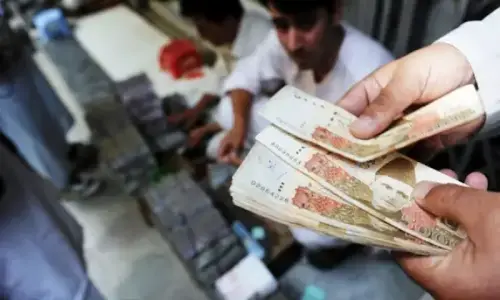
KARACHI, Oct 16: Pakistan received $981.53 billion net workers' remittances during the first quarter of this fiscal year, up 10 per cent from $890.31 billion received a year earlier.
Data released by the State Bank show the country got the largest chunk of $313.8 million remittances from the US followed by $161.1 million from the UAE and $158.5 million from Saudi Arabia.
Workers' remittances from Bahrain, Canada, Japan, Kuwait, Norway, Qatar, Oman and the UK also increased, though marginally in some cases, during the first quarter of this fiscal year.
Net workers' remittances of $981 million in QI have helped Pakistan offset the impact of an unusually large trade deficit during this period. The trade deficit in July-September 2004 widened to $839 million from just $144 million a year-ago chiefly due to a 38 per cent increase in oil import bill on the back of record-high global oil prices.
Increased imports of machinery and other capital goods as well as farm inputs also had a share in increased trade deficit. However, as oil prices continue to rise further and overall imports of the country are growing at much faster pace than anticipated, the resultant increase in the trade deficit cannot be offset by the workers' remittances.
That would mean an increased pressure on Pakistan's overall balance of payments that has already turned negative. The country saw a deficit of $788 million in its BOP in July-August 2004, whereas it had seen a surplus of $375 million in a year-ago period.
Thus, Pakistan needs to focus on attracting more and more of workers' remittances and foreign direct investment to offset the impact of its rising trade deficit. The policy-makers have somehow managed to keep the spread between the inter-bank and open market exchange rates at an appropriate level, around 50-60 paisa a dollar.
They badly need to maintain this to attract larger workers' remittances throughout the fiscal year. Bankers and officials of exchange companies say when the gap between official and open market rates rise beyond 50-60 paisa a dollar it does provide an incentive to expatriate Pakistanis to send foreign exchange back home through unofficial channels.
The recent moves made by the Pakistan Customs and the State Bank to check currency smuggling has also helped in keeping the differential between official and open market exchange rates at an appropriate level.
Pakistan can attract more of workers' remittances if the authorities step up efforts to root out currency smuggling under the guise of exchange companies operations and also provide the exchange companies the level-playing field with banks in terms of handling workers' remittances. These companies want a key amendment in the rules ensuring that the workers' remittances affected through these companies are treated on a par with those by the banks.