0
0

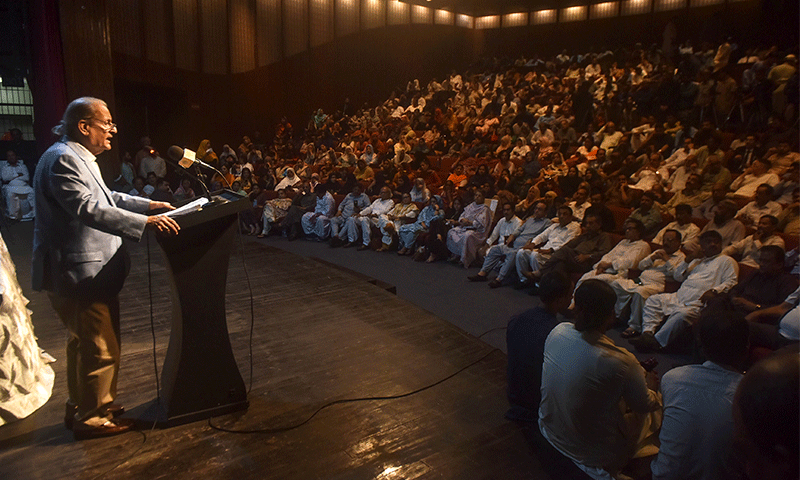
KARACHI, Nov 28: Celebrated art critic Prof Ludovico Pratesi presented a wide-ranging survey of the best contemporary Italian art at a conference organized on Saturday evening by the Italian cultural centre Dante Alighieri in collaboration with the national section of the International Association of Art Critics.
His survey, which was supported by a multimedia presentation, was titled 'Internationally renowned Italian artists 1970 - 2000".
Introducing the distinguished art critic to the audience, whose ranks swelled when a number of students from Karachi University joined, the Italian consul-general, Bruno Pasquino, said that Prof Pratesi was a well-known curator who contributed to prestigious international newspapers such as la Repubblica and Le Monde as well as to magazines including Panorama and Il Venerdi.
"The main goal of the Italian ministry of foreign affairs is to show abroad that Italian art and culture did not end with the 17th century. In this exhibition, as well as in the events organized in the future, the Dante Alighieri will seek to mix modern Italian art with Pakistan art. In this respect, we will bother potential sponsors to help us," he said.
Delivering his lecture, Prof Pratesi recalled that Italian art had witnessed two major movements over the past three decades. "The first movement began in 1967 by leading artists who were wedded to political ideologies.
Living in tumultuous times, the artists attended to political issues and took art outsides museums and conventional centres of art. They also made art accessible to the common man," he explained.
The art critic said that for 10 years in England, France, Italy, Spain and other European countries art remained fiercely against commercialization. "In the 1980s, the situation changed completely.
It began with an idea of 'open art' which found favour with leading curators who were from Germany, the United States and Italy. Most of them were very young. All these people generated a renewed interest in traditional paintings. Besides, their artworks were private and linked to the art market," he said.
Prof Pratesi noted that these two movements were very important for Italian art. "In the 1990s, the notion of 'multiculturalism' gained ground. It started with an exhibition in France. Before the 1990s, the art scene was composed of artists from Europe and the United States. But now you have participation from all over the world," he said.
Prof Pratesi expressed satisfaction over the emergence of new art structures in Italy, adding that the number of museums and centres of art had risen considerably over the years. After Prof Pratesi's lecture, an exhibition of water colours by Ghalib Baqar began.