0
0

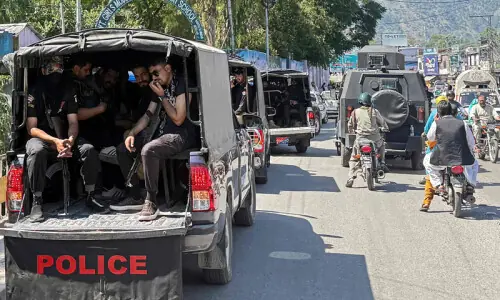
KARACHI, Sept 13: More than 150 foreign militants were killed in tribal areas since the operation was launched by the Pakistan army and 60 since Thursday in South Waziristan.
This was stated by Major General Shaukat Sultan, director general of the Inter-Services Public Relations during the 'meet the press' programme of the Karachi Press Club on Monday. He said that three security personnel had been killed in the area since Thursday.
He said that no civilian had been killed in assaults on militants' hideouts. Nevertheless, he said that despite utmost efforts to avoid collateral damage some civilians were killed earlier in one of the operations but the government had compensated and the president had expressed regrets.
He responded to criticism about the government's policy vis-a-vis tribal areas and Balochistan, defended establishment of cantonments and expressed concern over what he called a ring of Indian consulates working close to Pakistani border which he feared could be used 'for some other purposes'.
He reiterated the government's nuclear policy and claimed that nuclear assets and capability were well protected and there was no threat to them. In the context of the on-going military operation, the ISPR chief said that the prime responsibility of the government was not to allow its soil to be used for terrorist activities against any other country.
"If we would keep our eyes shut and take no action against terrorists operating from our soil, then what option will be left with the country against whom terrorist acts are committed from here", he asked
Asked to comment on information minister's remarks that had Pakistan not launched the operation the Americans would have done it, the ISPR chief said that if the terrorists would cross into Afghanistan and attack the Americans or the Afghans and if Islamabad did nothing to check them, in that event, Pakistan would have been construed as a terrorist-sponsoring state. "We will not allow any such opportunity to come," he said.
On a question about the so-called high-value targets, the ISPR chief outrightly denied that Al Qaeda chief Osama Bin Laden was in the custody of the Pakistan Army. It was just a speculation and there was no truth in that, he said.
Gen Shaukat Sultan gave a detailed account of the military operation in the Fata area and developments in Balochistan and through slides explained the ground realities, from the military's point of view.
He said that after the launching of the operation in Wana, some terrorists hiding in South Waziristan had moved to North Waziristan. He said that in a recent attack on a training camp 50 "terrorists were killed, most of them were Uzbeks and Chechens and some Arabs".
He also showed a video of the operation and the recovered computers, VCDs, CDs, cameras and a heavy quantity of ammunition including rockets and bullets from an underground cellar.
He rejected the contention that the terrorists had been propelled and trained by Pakistan Army during the Afghan jihad. Giving statistics relating to the current operation, he claimed that most of those involved in terrorist activities were aged between 20 and 30 years and they were not even on the scene after the fall of the Soviet Union.
He also rejected a perception that Pakistan had supported or trained Osama bin Laden and said that Osama was in Saudi Arabia at the time of the American attack on Iraq in 1991; he was expelled to Sudan and when the Sudan government expelled him he went to Afghanistan.
"Osama had never been in Pakistan nor Pakistan provided him any facility at any state of time", he added. He also rejected allegations that Pakistan was fighting America's war and said: "We are fighting against terror and extremism in our own interest".
Regarding the situation in Balochistan, he said that those who were opposed to its development were opposing Gwadar and cantonments. He pointed out that the a day before some Chinese were killed in Gwadar, an investor conference was to be opened in Quetta by the then prime minister Zafarullah Khan Jamali.
he was of the view that the sardars were resisting development because they feared that they would lose grip on the people. He said all terrorist activities in Balochistan were aimed to sabotage the development activities in the province and only some locals under the patronage of these 'sardars' were involved in it.
He told a questioner that Indian consulates set up in Afghanistan were being used by RAW for fomenting trouble in Balochistan. He said the government had taken up the matter with the Indian authorities during the Pakistan-India dialogue pertaining to terrorism.
He said that the government had decided to establish three cantonments in Balochistan which, he said, were necessary for "national security as well as the development of the province". He claimed that there was no army operation in Balochistan and action against criminals was taken by security forces to maintain law and order.