0
0
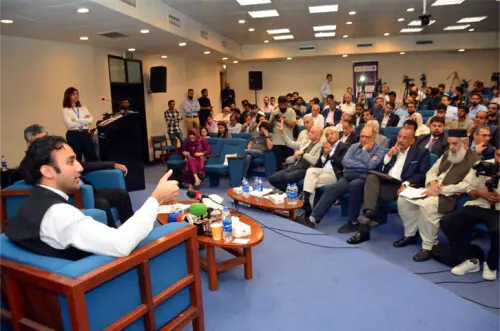
HYDERABAD, Sept 1: The two-day international conference on "Human Security: Global and Regional Perspectives", organized by the International Relations Department, University of Sindh, in collaboration with the Hanns Seidle Foundation , has recommended shared activities of people, individually and collectively, for the common good of humanity.
The recommendations presented by former ambassador Dr Ross Masood Hussain at the end of the conference on Wednesday were unanimously approved by the participants. It was recommended that one of foremost needs of the people of South Asia was human security that could be strong enough to overcome fears generated by unscrupulous and exploitative governing elites.
The conference observed that lack of human security was one single factor that constitutes the prime impediment to cooperative effort in South Asia because the prevailing concept of security was rooted in two conventional beliefs - the balance of power system and the myth of preparing for war for ensuring peace.
It observed these beliefs coupled with diplomatic practices that emanated from them had served only to reinforce an increasingly dysfunctional regional system and encouraged self- defeating policies by major actors in South Asia.
The participants of the conference believed that in practice the traditional security approach not only denied democracy by broadening the gulf between people but also discouraged democracy by legitimizing military take overs and autocratic institutions, giving nuclear-armed tin-pot rulers literally untrammelled power to pursue belligerent policies.
The conference noted that for the security problems of South Asia, the concept of people's security suggests a possible solution which in essence, means the nurturing of attitudes and values and devising of institutions that involve all people in a quest for security in all areas.
The conference was of the view that security in South Asia could only be achieved when its rival nations hold it as an objective in common and only when the people take a comprehensive view of security threats encompassing demographic, socio-economic, environmental, ecological, political, psychological and religious as well as military threats that could jeopardize their future.
"The comprehensive nature of human security pushes the conceptual change even further by moving it from just military security to people's safety from all life's major threats", it noted.
It said people's security thus represent an advance over traditional security policies in at least three areas. First, security policies begin with the assumption that all people of South Asia were brought together as a matter of their birthright to participate in and to determine decisions that affect their lives.
Second, policies should stress that security is for people and not just for political abstractions like governments or governing elites who only make themselves secure. Third, democracy stands for people's security and means a particular kind of relationship among tolerance and respect for other's point of view.
People's security, the conference said should not allow encroachments upon human dignity and violations of human rights. "There are no human relationships in the world, which in the ultimate analysis, are not facilitated by mutual respect, dignity and compassion", the conference emphasised.
The conference urged policy makers to create human security awareness through research and workshops on particular human security issues including water and ecological disaster, developing in the Indus Delta.
Former foreign secretary Najamuddin Shaikh appreciated the efforts made by the University of Sindh for holding the international conference on the important human life issue.
He appreciated the university for providing an opportunity to young students to learn and listen to views of scholars and also share their views on this important issue of human security.
Dr Alexander Niktin, the director of the Centre for Political and International Studies, Greece, said Lahore was the cultural capital of Pakistan, Karachi was financial capital and Jamshoro was the academic capital".