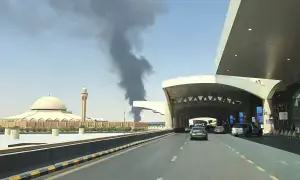
KARACHI, April 21: Less than half of the solid waste generated every day in residential and commercial areas of the city is not collected and left for commercial exploitation by scavengers or for burning openly in road-side dumping sites , open amenity/private plots.
Yet another purpose of not lifting it is to let the garbage be dispose of naturally. The improper handling of solid waste and littered construction debris contributes significantly to widespread pollution and lead to insanitary conditions.
This would be one of the main points of the agenda to be taken up by policy makers, administrators and the 14 million Karachiites who are observing the international Earth Day on Thursday.
Inquiries suggest that a quantity of about 8,000 tonnes of domestic waste is generated every day in the city, in addition to often hazardous industrial and medical waste. Only 40 to 50 per cent of the waste is collected and taken to some designated landfill sites by the local government or cantonment boards. Ditches and river channels are also used as dumping sites by unauthorized people.
Over the past decades or so, there has been much talk by authorities about measures like handing over the entire waste disposal operation to private parties, running of garbage trains, and establishment of garbage transfer stations. However, none of such plans has materialized so far.
The widespread use of polyethylene/polypropylene or plastic bags, considered hazardous for the city's environment and civic amenities, has also remained a major issue and could not be resolved till date.
The authorities are fully convinced that there should be a strict ban on such bags but they could not enforce the ban for reasons best known to them, said a citizen.
Progress in the case of hazardous hospital waste is also not very encouraging. The dangerous waste is often seen littered in the vicinities of hospitals, health care centres and, in some localities, thoroughfares.
This poses a serious threat not only to public health but also to the entire environment. The problem persists apparently due to the lack of the number and capacity of official incinerators.
Scientists and experts are of the view that Earth Day originally aims at putting environment into the political limelight once and for all. The theme of Earth Day 2004 is One Earth One People. The events on the Day, observed since April 22, 1970 when about 20 million Americans had held a rally, focus on concerns about what is happening to the universe - land, rivers, lake, air, etc.
DUHS SEMINAR: The Dow University of Health Science (DUHS), in collaboration with the University of Karachi and National Forum for Environment and Health (NFEH), held a seminar on Wednesday as part of the Earth Day celebrations. The seminar was presided over by Vice-Chancellor of the DUHS Prof Masood Hameed.
It recommended environment education for children at every level along with group activities. It called for effective management of potable water distribution system and waste water system to avert contamination and loss of water.
The seminar urged the government to compel industries to treat and recycle their effluents and also check gas emission from their units. It also suggested that freshwater reservoirs and channels must be protected from effluents.
Earlier, Prof Masood Hameed called for measures to check also sorts of pollution - air, noise, water etc. - which is causing adverse effects on human life. He stressed the need for joint efforts by educationists and environmentalists in order to highlight the concerns about human health effectively.
The Director of the Institute of Environmental Studies, University of Karachi, Dr Nayyer Alam Zaigham, discussed the problem of water and air pollution and maintained that the human activities were contributing enormously to the environmental degradation.
He said that Karachi, a fishing village of past, had seen an expansion from 233 square kilometres in 1947 to over 3,530 square kilometres owing to the fast increasing population and influx of low-income group people from other parts of the country.
However, he pointed out, the city had not been developed as per any town planning framework which resulted in the occupation of even river channels. Dr Zaigham observed that flushing of untreated sewage into rivers, and profusely leaking sewage lines were some of the factors contributing to contamination of ground water.
The NEFH Vice-President, Mr Sirajuddin, said that activities like sending chemical (smoke) in the air, discharge of untreated water, burning of waste and vehicular traffic emission were a matter of serious concern as they contribute to air and water pollution as well as bio-diversity depletion.
Dr Moazzam Ali of the Institute of Environmental Studies, University of Karachi, highlighted global warming issue and suggested that fossil fuels burning be avoided and forest fires prevented.
Referring to the analysis of water samples collected in the city, he disclosed that all the samples of ground water and 60 per cent of those taken from piped water in different localities were found unfit for human consumption.
Dr Salim Ilyas of the DUHS also spoke on the occasion. Dr Syed Anzar Ahmed Rizvi read out the seminar's recommendations and said that environmental issues had no boundaries, therefore, they should be shared by every nation on the earth in terms of reduction, solution, mitigation and sharing of technological expertise so that future generation could enjoy a neat and clean environment.