0
0

ISLAMABAD, Jan 17: The government will take bold steps to overcome the energy crisis, says President Asif Ali Zardari.
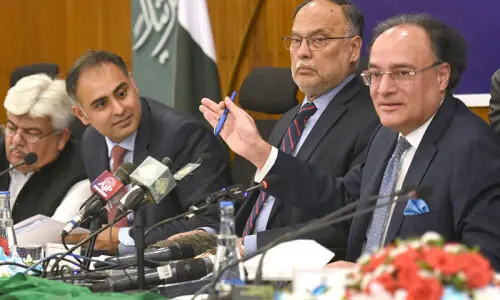
“The previous PPP government had successfully overcome loadshedding with its IPP initiative and it is again ready to adopt bold measures to resolve the energy crisis,” he said co-chairing a meeting to review progress on the Thar coal project with Prime Minister Yousaf Raza Gilani.
President Zardari stressed the need for accelerating work on the coal project by removing bureaucratic bottlenecks and said that Pakistan had rich energy resources which had not been fully tapped because of which the people were facing loadshedding.
The meeting was informed that seven international finance companies and over 80 investors attending a conference organised by the World Bank in Washington in July 2008 had showed interest in the project. The World Bank had agreed to provide technical assistance for the project.
The meeting was informed that the Thar coalfield contained 175 billion tons of coal over an area of over 9,000 square kilometres, promising fuel availability for a long time.
A World Bank team was already in Islamabad for meetings with officials of the federal and Sindh governments on the issue.
The federal government has already commenced work to develop the support infrastructure under the Thar Coal Infrastructure Development Project. The Sindh government has invested a huge amount in building a network of roads and water and power supply systems and town planning.
The coal deposits were discovered in Tharparkar district by the Geological Survey of Pakistan (GSP) in 1992. The find later turned out to be the second largest in the world with confirmed reserves of 175.5 billion tons of coal. The Thar coal is of lignite A-B quality which contains very low quantities of ash and sulphur and is suitable for power generation, with relatively less adverse environmental and ecological effects.
The coalfields were initially divided into four blocks for administrative and logistic purpose. Two new blocks have been added, thus making a total of six blocks for exploration. Different blocks are being offered to the private sector for installing power plants of up to 1,000-MW.
In April 2002, a state-run Chinese company Shenhua Group Corporation was assigned to develop block 2 of the coalfields, accepting its proposal to establish a 600-MW plant at the mine-mouth with associated captive coalmines.
The Chinese group had also finalised a project feasibility report. Unfortunately, the project ran into snags.