0
0

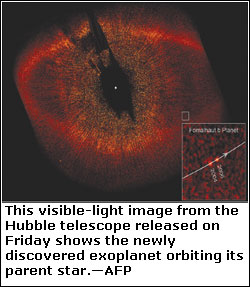 WASHINGTON: After an eight-year quest for images, a US astronomer using a camera aboard the Hubble space telescope has snapped the first picture of a planet outside our solar system.
Astronomer Paul Kalas captured the first visible-light images of a planet some 25 light years from our solar system using a camera mounted on the Hubble telescope.
Likely similar in mass to Jupiter, the planet is orbiting the star Fomalhaut in the southern constellation Piscus austrinus at a distance of about four times the distance between Neptune and our sun, said the study’s lead author Kalas, with the University of California, Berkeley.
The research appears in the November 14 online edition of the review Science.
The planet, dubbed Fomalhaut b, could have a system of rings similar in dimension to what Jupiter had in the past, before dust and debris joined together to form its four main moons.
Kalas suspected the planet’s existence back in 2005, when images Kalas took with the Hubble Space Telescope’s Advanced Camera for Surveys showed a defined inner edge to the dust belt around Fomalhaut.
The edge and off-centre belt made Kalas think a planet was in an elliptical orbit around the star.
“The gravity of Fomalhaut b is the key reason that the vast dust belt surrounding Fomalhaut is cleanly sculpted into a ring and offset from the star,” Kalas said. “We predicted this in 2005, and now we have the direct proof.”
“It will be hard to argue that a Jupiter-mass object orbiting a star like Fomalhaut is anything other than a planet,” said coauthor James Graham, professor of astronomy at UC Berkeley. “That doesn’t mean it’s exactly what we expected when we went hunting for planets in this system.”
The report in Science will be followed by an article to appear in The Astrophysical Journal (ApJ) evaluating interaction between the planet and the dust belt surrounding Fomalhaut.
“Every planet has a chaotic zone, which is basically a swath of space that encloses the planet’s orbit and from which the planet ejects all particles,” said Eugene Chiang, a UC Berkeley associate professor of astronomy and of earth and planetary science, and first author of the ApJ paper.—AFP