0
0

LAHORE, Nov 8: The Minister for Water and Power, Raja Pervaiz Ashraf, has said that a revised power tariff would be announced by Tuesday.
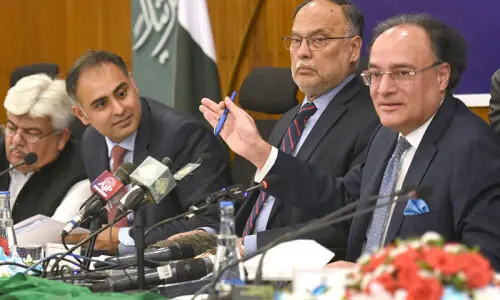
He told a press conference on Saturday that the new tariff was designed to protect lifeline (up to 100 units) and middle class (up to 300 units) consumers.
The minister said an attempt would also be made to provide relief to the industry so as to keep the country’s products competitive in the world market.
Discussing the circumstances leading to the last tariff revision, he said that the Pakistan Electric Power Company (Pepco) had a deficit of Rs185 billion when the present government took over. The government, however, contributed Rs65 billion, leaving a gap of Rs120 billion, he added.
He said by revising the tariff the government had decided to pass on a burden of Rs47 billion to consumers instead of Rs120 billion.
He, however, refused to divulge details of new tariffs and said: “It would only be clear by Tuesday when all options are considered and best one is picked” in the light of opinion of people from different walks of life.
Defending the inclusion of up to 30 per cent taxes in electricity bills, he said that taxes would have to be levied under a certain formula and the general sales tax would not be withdrawn.
He conceded that abolition of slab system would hurt the consumers. Mr Ashraf said that the provinces could be allowed to generate power beyond the current limit of 50MW if they possess technical know-how. There were some issues that should be tackled before allowing the provinces to generate more than 50MW, he added. He, however, said that all the energy would have to be sold through Pepco.
Talking about the canal closure period (Dec 20 to Jan 20) and its impact on power generation, the minister said that Pepco was aware of the situation and had devised a plan to deal with it. During that period when no water was released from dams and the hydel power generation dipped to almost zero, Pepco had devised a two-pronged strategy, he said.
He said no plant should go off line and the required oil was stocked. This would lessen the load on people, he added.
Mr Ashraf said that the increased water releases from dams had helped in reducing the loadshedding hours, but the ministry would only be satisfied when additional 5,000MW was injected in the system and the problem was resolved permanently.
The minister reiterated the government’s resolve to end loadshedding by December 2009.