0
0

 The Karachi Stock Exchange (KSE) has outperformed all exchanges in developing countries till very recently. Yet, the total number of companies listed at the KSE has actually gone down, from 701 in 2002 to 654 at the end of 2007.
More companies are getting themselves unlisted (or being removed from the list) than new firms opting for listing. While the KSE index had grown from 2,701 at end 2002 to 14,075 at end 2007 — a remarkable annual growth rate of 31.62 per cent — the total paid-up share capital of these firms had grown only negligibly if the bonus issue shares are not counted.
At the end of 2004, total market capitalisation was Rs1,723 billion and at end 2007 it stood at Rs4,330 billion; yet the total fund raised through rights or new issues during this period was only Rs79 billion (inclusive of share premiums). What did it mean? Could it be a lack of investors’ confidence in companies? Why was there such a lack of public confidence in companies listed at the best performing exchange in the developing world? In one phrase: it was a perception of poor corporate governance at these companies.
Corporate governance is attracting a lot of attention in the developed world. While there have not been any scandals of Enron or WorldCom proportions in Pakistan as yet, it is not to say that companies are not exposed to the ills of poor corporate governance policies.
The regulators have already brought out a voluntary Code of Corporate Governance while an Institute of Corporate Governance has also been set up. All this will certainly lead to improving things in the long run, but considerably more needs to be done now.
Having sat on the boards of four listed companies for over a decade and later having observed the performance of stock exchanges as an academician for another decade, I have come to believe that the best way to define corporate governance, both as a field of study and a management phenomenon, is to take the stakeholders’ perspective route. For this purpose, the first step is to classify stakeholders. We can classify stakeholders in a listed company in two different ways.
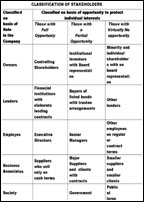
The first is on the basis of their respective roles in a company. On this basis, one can say stakeholders are owners, lenders, employees, business associates and society at large. Owners include all sorts of shareholders like those who do or do not control the company, individuals as well as institutional investors, long-term holders as well short-term players, those with voting rights and those without them, etc. For the purpose of this classification, the term lenders has been used to include only those who extend financial advances to companies, rather than credit for services rendered or trade goods supplied.
These may be formal financial institutions or individuals (those who buy bonds, or grant loans through asset management firms). Employees,of course, include executive directors, senior managers and others who are on the pay roll of the company.
Business associates are company’s suppliers and clients while the society includes public at large as well as the government. All these stakeholders (owners, lenders, employees, business associates and society) stand to benefit or lose from a company’s performance and state of affairs.
Another potent way of classifying stakeholders is on the basis of how much opportunity they have to protect their respective interests. On this basis, stakeholders either have full opportunity, a limited opportunity or relatively no opportunity to protect their interests. Now if one tries to list the stakeholders, using both of the above bases of classification in one table, it would appear as follows:
Every class of stakeholders has its own particular interests. The interest of owners lies in sustainable growth in the net worth of the company, lenders require security of their investment and assurance of timely interest payments, employees want continued employment at attractive terms, business associates seek opportunities to further their own profits while the society looks up to the company to be a good citizen. Quite understandably, the interests of these stakeholders often clash with each other.
For example, the interest of owners is often ’best’ served by depriving the other stakeholders of their rightful dues. Inadequate salaries to employees, lower prices to suppliers, higher charges to clients, tax avoidance, disregard of social obligations, all contribute to higher profits for the company.
And then, there is the overall interest of the company, which I refer to as the collective interest of all the stakeholders, namely the continued profitable existence of the company.
Decisions made by a company affect all the stakeholders; yet only a few of them have influence on the company’s decision-making process. Now, those stakeholders (like controlling shareholders, larger institutional lenders, executive directors, etc.) who have greater influence on the company’s decisions, can ensure the protection of their interests without having sufficient regard for the interests of all the other stakeholders, or of the collective interest of the company. Decision-makers are not always likely to stop at mere protection of their narrow interests. They often cross the line and try to enrich themselves by actually depriving other stakeholders of their rightful dues.
There is a need for a mechanism that will ensure that: (a) the individual interest of each stakeholder is served and protected, (b) the collective interest of all the stakeholders is served and protected, (c) no stakeholder is allowed to expropriate the interest of other stakeholders, and (d) no single stakeholder enjoys a monopoly over the decision making process of a company. Corporate governance is that mechanism.
I therefore define corporate governance as, “the mechanism used to conduct the affairs of a corporate body in order to serve and protect the individual and collective interests of all its stakeholders”.
The mechanism to conduct the affairs of a corporate body includes all laws, professional codes, industrial practices and management techniques. When I state the first objective of using these tools as protecting and serving the individual interests of each stakeholder, I refer to the appropriate application of the various agency theories that abound. And when I say that the second, equally important, objective is to protect and serve the collective interest of all stakeholders I extend the list of basic tools (laws, professional codes, industrial practices and management techniques) to include strategy development, image building and risk management.
The writer is Dean of Faculty of Management Sciences at Mohammad Ali Jinnah University, Islamabad