0
0

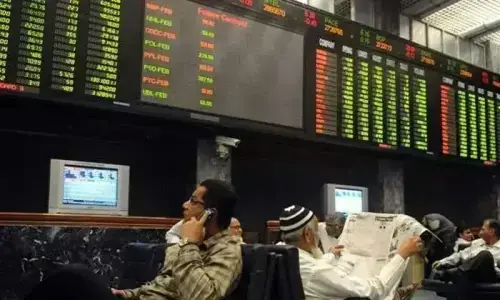
KARACHI, May 15: Foreign investors are rarely regarded as a panic-prone herd. But the pullback of the stock market from its climb earlier in the week, demonstrated that what the market had witnessed was a respite rather than a rebound.
Market participants said on Thursday that the foreigners had reasons to quit, one being the hefty rupee devaluation. “If that was not enough, Pakistan’s downgrading to ‘B’ from ‘B+’ by the international rating agency Standard & Poor’s, added fuel to the fire,” said a trader who handles institutional sales for a large brokerage house.
“Advice to our dearest clients is to brace themselves for some weird movements on the bourses as the country’s macro-level economic issues sink in. Moreover, budget proposals and a potential delay in its presentation, owing to the resignation of the finance minister can make it difficult for the bulls to return,” says Faisal Bilwani, analyst at Elixir Securities.
In the “country overview”, Merrill Lynch stated on Thursday: “We are generally in agreement with S&P on the rising macro headwinds that prompted the downgrade. However, we believe the government’s recent aggressive oil price pass-through indicates its seriousness in controlling fiscal deficit. We also believe that the rising external deficit would be financed through cheap financing from external sources and with help from friendly countries (for e.g., China, Saudi Arabia, US and Japan)”.
And finally Merrill Lynch had something heartening to say: “Overall, we believe the headwinds are more or less priced-in and unlikely to affect Pakistan’s future structural flows”.
But concurrently, economists are revisiting their earlier outlook on the country’s economy. Muzammil Aslam, analyst at KASB Securities, said his house was cutting down on FY08 GDP estimate to 5.5-5.75 per cent, prompted by the slowdown in consumption and investments.
“Trimming of FY08E GDP growth target is on the back of weak industrial activity, reflected in July-Mar 08 industrial output growth of 4.84 per cent,” says the economist, adding that it was significantly lower than their full-year target of 8.3 per cent, which was feared to lead to lower demand for services and hence reduce GDP growth.
Muzammil said that the weakening of ‘fundamentals’ was due to domestic and global woes. Relative slowdown in FDI coupled with a cut in development expenditure target (by Rs100bn or 19 per cent) was expected to result in a slowdown in investment growth. Simultaneously, higher inflation could trim purchasing power.
“Pakistan has witnessed 20 per cent food and 13 per cent headline inflation in the past four months,” the economist noted. That was believed to lead to a serious risk to domestic consumption. Already the import growth numbers for autos, beverages and other consumer imports were showing a declining trend. Import growth was higher but not quite widespread.
Visible slowdown in domestic consumption was reflected in the negative trend of real import growth for the bulk of consumer durables. The inflated import numbers were attributable to high volumetric and price growth of crude oil, wheat, cotton and power generators.
“Due to a poor agriculture year, Pakistan has imported bulk quantities of wheat and cotton, while domestic power woes have led to the increase in heating oil and power generating machinery imports,” says the economist.
A veteran stockbroker, echoing concerns of the market lamented that the uncertainty on the political front was taking its toll.
Referring to the unending merry-go-round of talks between the two major political parties, over the same issue and now a possible parting of ways, he commented: “They call it separation and not divorce”. Whatever that be, he said, it was time that the two major political parties voted to power, start shifting thought from their ‘marriage of convenience’ to public problems of gnawing inflation.