0
0

RAWALPINDI, April 30: A number of celebrations including street demonstrations and labour-oriented events will mark Labour Day throughout the country on Thursday.
After decades, the day will be observed in Pakistan with a renewed zeal by the labour community following lifting of ban on trade unions a month ago.
Labour Day is an annual holiday celebrated all over the world that resulted from efforts of the labour union movement to recount the economic and social achievements of workers.
Labour unions, restored in the public and private sector industries, corporations including PIA, Wapda, PTCL and Pakistan Railways etc., will commemorate the event with the pledge to protect workers’ rights besides playing a role for development of the country.
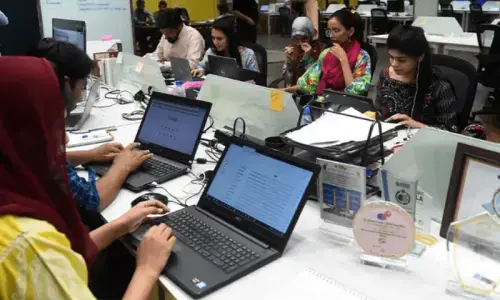
According to the latest survey, there is nearly 47 million employed labour force in Pakistan; whereas only three million workers are unemployed out of 50.05 million total labour force. Pakistan is a country with about 25 million youth of 18-25 years age group but a small percentage - 1.7 per cent - of them are able to make contribution to the national economy by applying their training and education.
Around 540 technical and vocational institutions have the capacity to produce only 200,000 skilled people every year which is inadequate as compared to the demand of the economy and the country’s population. Just focusing on enhancing the enrolment in technical institutes is not enough, an official report says.
The overall employment and labour market situation in the country continues to draw attention in economic and social policy making. In order to make the conditions conducive for employment creation government needs to identify and remove perverse incentives that bias investment towards capital- intensive techniques. For this, there is need to adopt a sectoral approach to create conditions for investment in employment intensive industries, says the report.
The Pakistani working age population is estimated to be 105.37 million. However, a significant number of this is not part of the economically active population. Those not active in the labour market include housewives, students, handicapped, senior citizens, etc.
Today, the world of work is being profoundly transformed. Sectoral shifts, in themselves, are making the old images of full-time, single-occupation labour and employment inappropriate as guides to the future.