0
0
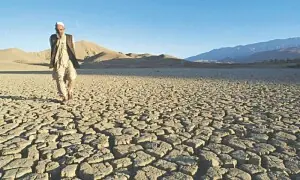
DADU, April 27: At least three children died of waterborne diseases in three days and on an average one person was losing life every fortnight in the villages on the embankment of Manchhar Lake because its water had become too toxic for human consumption, found a survey on Sunday.
The survey conducted by Dawn found that people in the villages particularly women and children, suffered from waterborne diseases like gastroenteritis, tuberculosis, malaria etc.
Around 20,000 to 25,000 village people have no facilities of health, water supply and education and the government has done virtually nothing for their betterment.
Many villagers complained that the high toxic levels in the lake water had made the fish scarce, which was their only source of livelihood, and they were unable to provide even two square meals and medicines to their children.
Local fisherman Ghulam Qadir Mallah of Bund Manchhar village blamed continuous release of saline water from Chhandan into the lake for the spread of diseases.
Late Benazir Bhutto had ordered a water supply scheme for the villages during her last government but then work on the scheme stopped after dissolution of her government, he said.
He said that the PPP was once again in power but the party’s elected MPAs and MNAs were least concerned about the problems of their electorate. Deaths of infants were common in the Lake area, he said.
He said that the poor fishermen had to buy drinking water for Rs20 per 10 litre can. The high toxic levels had on the one hand led to diseases and on the other led to shrinkage of their catch, he said, adding that they hardly caught 3 to 4 kilogramme of small fish, which they were selling to local traders at the rate of Rs4 to 5 per kg.
Another fisherman Moula Bux Mallah of New Model village hoped that elected MPA Syed Murad Ali Shah would make efforts to provide them facilities of drinking water and health.
He said that three children had died of waterborne diseases in the catchment area of Bund Manchhar Lake. Fish were also dying due to polluted water, he said.
He said that one or two persons were dying at different places around the lake in 15 days. The nearest Basic Health Unit had no medicines to give its patients, he complained.
An affected woman Rehmat Mallah of Girkano village said that her family was dying of hunger and they had no clean and freshwater for drinking. Their major problem was waterborne diseases, she said.
She said that politicians cashed in on Benazir Bhutto’s assassination to get to power corridors but now they did not bother to come to their constituencies and solve their problems.
The executive engineer of Irrigation Department’s Southern Division, Habibullah Kabooro, said that 2,500 to 3,000 cusec of saline water flowing into the Lake from Chhandan was polluting the water.
He said that the solution of the problem was in the construction of RBOD. If the RBOD was constructed then saline water of the lake would be drained out to sea, he said.