0
0

KARACHI, Dec 5: The government made heavy borrowings from the banking system for budgetary support during the first five months of the current fiscal year amid mounting pressure arose from high international oil prices.
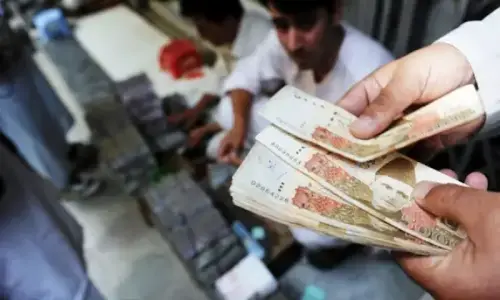
The borrowing put more pressure on the State Bank which had to lend heavily to the government which translated into the higher currency supply. The government borrowed Rs145 billion during July-November period which was more than double when compared to Rs62 billion it borrowed the same period last year.
Of the total borrowing, the government raised Rs122 billion through the State Bank. This had been a serious concern for the central bank which had been requesting the government to find new resources for fund raising. The heavy borrowing puts pressure on the monetary policy that targets inflation.
However, the government kept borrowing heavily despite higher revenue collection and reduction in development expenditures for the current fiscal year, which had been causing inflationary pressures.
Analysts said the economy was already under tremendous pressure due to rising oil prices as the government had not been passing on the impact of this increase to the consumers for the last several months, which cost it Rs101 billion.
Some analysts said the government had yet to take any decision in this regard though the ‘loss’ of Rs101bn had provided enough reason to raise petroleum prices at least by 20 per cent.
They believe that the inflation could touch double digits if the government opts to raise POL prices.
Inflation, measured by CPI, had already entered an alarming zone during last few months. In October 2007, the CPI recorded 9.31pc growth which was 1.23pc higher month-on-month basis. The increase was mainly attributable to the rise in food prices. The food and beverage, with 40pc weightage in the overall CPI basket, registered a growth of 14.67pc on yearly basis in October 2007.
Analysts say the fuel price hike is less harmful than the food prices in the CPI basket, but the cyclic impact of the higher oil prices will hit almost all sectors including the food prices. The reports of shortage of wheat could add fuel to the food inflation as the wheat prices were also on the rise.
Most of the analysts have started reviewing their earlier calculation about the inflation for the year 2007-08 after record oil prices and shortage of wheat in the country. A research head of a brokerage house said the inflation could touch double digit if the trend in oil and wheat prices continued.
He said recent hikes in cement and steel prices were also anticipated to cause a house rent index increment. The house rent index was also expected to move up by 8.5pc on yearly basis as against 7.8pc last month.
“We are revising full year FY08 inflation estimate to 8.9pc from previous 7.5pc. Moreover, if 0.8pc monthly increment becomes a trend for upcoming months, a possibility of double digit inflation from January (also at the year end) cannot be ruled out,” said the research.