0
0

KARACHI, Nov 14: The Provisional Constitution Order promulgated by the army chief of staff has no precedent even in Pakistan’s chequered constitutional history, former chief justice Saiduzzaman Siddiqui told a general body meeting of the Sindh High Court Bar Association (SHCBA) on Wednesday.
Mr Siddiqui, who was relieved of the office of chief justice of Pakistan on his refusal to take oath under the October 1999 provisional constitution order, said this is the first time that an army chief has suspended the Constitution in the presence of a functional president and prime minister. Though he combines the offices of president and army chief, Gen Pervez Musharraf deemed it necessary to act in his capacity as the army chief of staff. The proclamation, in fact, amounted to the imposition of martial law, he added.
An emergency under the Constitution, the ex-CJ said, could be imposed by the president on the advice of the prime minister and would confer no authority on the army chief to hold the Constitution in abeyance. That was why an extra-constitutional emergency was preferred over a constitutional emergency. The new PCO enabled Gen Musharraf to administer a fresh oath to the superior court judges and purge the judiciary of its members who were taking an independent stance in accordance with the Constitution.
A constitutional emergency would have left the judiciary intact and free to circumscribe the executive’s powers or even declare the proclamation illegal and unconstitutional. An emergency under the constitutional provisions also requires the approval of the parliament, he said.
Thus the Nov 3 proclamation, Justice Siddiqui said, was the only constitutional deviation aimed not at the executive but the judiciary. Because of the absence of a plausible justification, it was the weakest of the proclamations the country had been subjected to and could not stand judicial scrutiny.
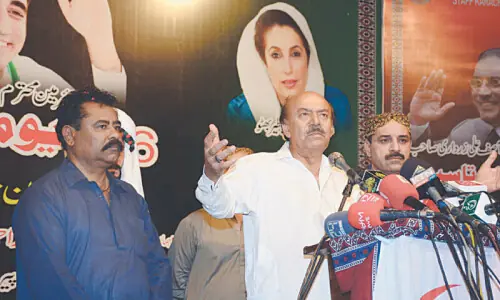
The general body later passed a resolution condemning the continuous arrests of lawyers, the latest being those of former SHCBA presidents Abdul Hafeez Lakho and Akhtar Hussain and incumbent secretary Munir-ur-Rahman. Advocate M. Ilyas Khan, another SHCBA ex-president who conducted Wednesday’s meeting, told the general body that former chief justice Ajmal Mian would chair Thursday’s session.
International concern
Meanwhile, the Law Association of Asia and the Pacific (LAWASIA) has expressed its deep concern over the developments in Pakistan, particularly the suspension of the Constitution. The measures taken to suppress the judiciary could not be countenanced by the international community, said a statement issued by the association.
The organization condemned the detention of lawyers, including its council member Rasheed A. Razvi. It supported the struggle for the rule of law and called for the release of all detained lawyers and the reinstatement of all judges who lost their offices as a result of their refusal to take a new oath under the PCO.