0
0

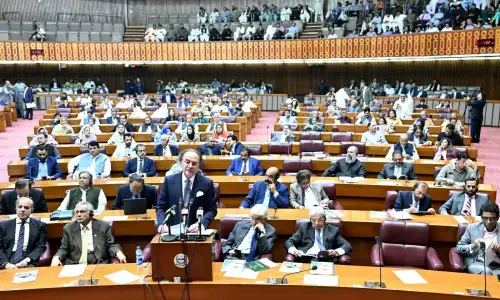
NEW DELHI, March 18: The lower house of the Indian parliament on Monday approved a controversial anti-terrorism law, despite strong resistance from opposition parties and human rights groups.
“The bill is passed,” deputy speaker P.M. Sayeed told lawmakers, with 261 votes in favour and 137 against.
However, before it can become law, the Prevention of Terrorism Ordinance (POTO) will need approval from the upper house, where the ruling Hindu nationalist Bharatiya Janata Party-led coalition government does not have a majority.
POTO, announced after the Sept 11 attacks in the United States, sets strict new rules for arrest, interrogation and investigation and allows suspects to be detained for 30 days without appearing before a court.
It defines a “terrorist” as anyone threatening India’s unity as well as causing terror among people.
“When we ask our security forces to crush terrorism how can we not empower them with adequate powers,” Home Minister L.K. Advani said before putting POTO to vote.
“We have incorporated several safeguards that have been suggested by the Supreme Court and by lawmakers and so there should be no controversy,” Advani said.
Opposition parties have described the bill as draconian and blocked its passage at a session of parliament in December.
It was reissued after the Dec 13 attack on the Indian parliament.
A ruling party official said on Monday if POTO was defeated in the upper house the government was likely to call a joint sitting of both houses to approve the decree — a rarely-used constitutional provision. The coalition has a majority when the two houses are combined.
Opposition parties and human rights groups have criticized the decree, saying it could be used to harass innocent people and target Muslims.
The government says it requires POTO to quell rising violence in occupied Kashmir and in the northeast.
“It empowers authorities to put anyone in jail without bail,” S. Jaipal Reddy of the Congress said. “This law is so flawed...we have no option but to oppose it.”—Reuters