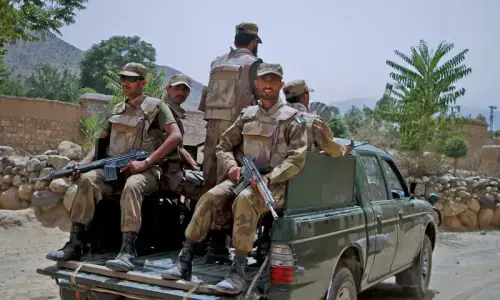
ISLAMABAD, Sept 13: A planned effort is being made to revise the composition of the Pakistan Army by reducing the dominance of Punjab to a considerable level over a period of four years.
In 2001, the Punjabis constituted over 71 per cent of the army. The numerical strength was reduced in later years and has been brought down to just over 57 per cent this year. A further three per cent decrease in recruitment from that province is on the cards by 2011.
The information is part of a booklet titled ‘Information Brief’, published by the Inter Services Public Relations (ISPR) Directorate, the official mouthpiece of the Army, released to counter the growing criticism at home and abroad over the composition of the military and the riches it has accumulated over the years, turning it into the country’s biggest corporate giant.
The booklet has also countered the figures indicating the size of the land being controlled by the army mentioned in Ayesha Siddiqa’s book, ‘Military Inc’.
Within a decade (2001-2011), the composition of Pakhtuns in the army would increase by one per cent to 14.5 per cent.
A two per cent increase will be made in the number of Sindhis bringing their total strength to 17 per cent by 2011.
The representation of Balochis, which was nil in 2001, constitutes 3.2 per cent at present. Their composition would be increased to 4 per cent by 2011.
Similarly, with their zero per cent presence in the army seven years ago, the people from Azad Kashmir and Northern Areas now constitute 9.11 per cent of the army. However, their number would be curtailed to 9 per cent in 2011.
By 2011, it will be ensured that at least one person from the minorities is among hundred personnel of the armed forces. At present they constitute just 0.72 per cent while seven years ago, their presence was just 0.29 per cent in the army.
CORPORATE ACTIVITIES: The booklet has claimed that a total of 833,268 acres was allotted to the armed forces since independence and not over 2.30 million acres as put by Ayesha Siddiqa in her book.
According to the ISPR, the current asset base of Fauji Foundation is over Rs125 billion.
It has provided details of the numerical strength of Bahria and Shaheen foundations and their activities and projects.
The Army Welfare Trust (AWT), with its present worth of Rs108 billion, employs over 11,000 people included retired military personnel and next of kin of Shuhada and those wounded in wars. The trust has 30 big and small projects in the country, including Askari Cement Factory, Nizampur, Army Welfare Sugar Mills, and Badin and Khoski Farm near Badin.
The Frontier Works Organisation (FWO), a segment of army engineers and national construction, employs 12,000 personnel and implemented construction projects of Rs141billion. These include the ongoing 66 projects at an estimated cost of Rs90 billion.
The National Logistic Corporation (NLC), one the leading public sector transportation and construction organisations in the world, has employed 97 army officers, 27 retired army officers and 2,634 junior commissioned officers with a turnover close to Rs6 billion last year.
The ISPR says that a ‘few’ serving officers are also employed in the administration of Defence Housing Authority (DHA), which is expecting Rs150 billion direct investment in its ongoing and planned projects. The authority runs 19 schools and nine colleges. It pays Rs6.5 billion tax to the government every year.
FARMS: According to the ISPR, there are nine military farms with a total area of 25,159 acres. Military farms in Okara and Rensala consist of two dairy factories, seven military farms and 22 villages. The total land involved is 20,156 acres. The booklet has also lauded the development activities of armed forces and its different organisations in Balochistan, Sindh and the federally administered tribal areas (Fata).