



 0
0

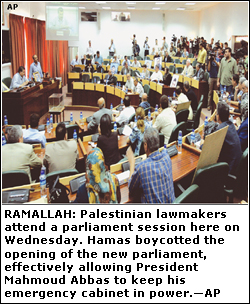 RAMALLAH, July 11: A boycott by Hamas MPs prevented the Palestinian parliament from convening on Wednesday, clearing the way for president Mahmud Abbas to exploit the paralysis to extend the mandate of his emergency cabinet.
“The session will not convene,” deputy speaker Hassan Khreisheh announced after only 44 lawmakers from the 132-seat chamber showed up at the session in Ramallah. Sixty-seven deputies must be present for parliament to meet.
Khreisheh said he hoped that parliament could convene within a week.
A senior legislator from Abbas's Fatah party said last week that if parliament did not meet, the president could invoke the section of Palestinian basic law that allows him to issue decrees that have the power of law.
One such decree could be to prolong the mandate of the emergency cabinet that Abbas installed on June 17, two days after militants from Islamist Hamas overran forces loyal to the president in Gaza.
Hamas MPs boycotted the session, which the chief of the Islamists' parliamentary bloc, Salah al-Bardawil, called illegal on Tuesday.
Non-Hamas deputies in Gaza were due to participate in the session by video from a conference room in Gaza City, but Hamas prevented the opening of the specially-outfitted room, officials said.
Amid a political crisis following Hamas’s Gaza takeover, Abbas last week authorised parliament, where the Islamists lost their practical majority after Israel arrested 39 of their MPs, to meet on Wednesday for the first time in months.
Hamas holds 74 seats in the 132-member chamber, compared to Fatah’s 45.
The Western-backed president, who has ruled out dialogue with Hamas after it seized control of Gaza, decreed that a new speaker be elected by secret ballot before any other parliamentary business.
Hamas has prevented parliament from meeting for months by keeping its MPs at home, fearing that Fatah will elect its own speaker to replace the arrested Aziz Dweik from Hamas, or adopt laws against the interests of the Islamists.
Senior Fatah MP Azzam al-Ahmed said last week that if parliament does not meet, Abbas will invoke “article 43 of the basic law.” That provision gives the president “the right in exceptional cases... and while the Legislative Council is not in session, to issue decisions and decrees that have the power of law.” Abbas could therefore prolong the mandate of his emergency government, sworn in for one month on June 17, after he dismissed the previous Hamas-run cabinet.
After the annulment of Wednesday's session, Fatah said in a statement that “the previous PLC presidency no longer reflects the will of the PLC and cannot pretend to speak in its name.” A Hamas deputy, Hatem Qafeisheh, recently released by Israel, was present at the building, but did not take part in the session and appealed for dialogue between the two feuding Palestinian factions.
He said he came “to send a message calling all political men to cease fighting and renew a dialogue.”—AFP



























