0
0

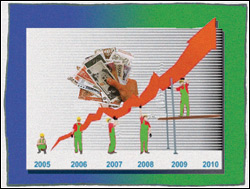 The government’s failure in announcing an over-due seventh NFC Award before the budget 2007-8 is a breach of the Constitution's Article 160. The award is pending since 2002 and delay in the fair and equitable distribution of national resources has crippling effects on the economies of the federating units. Pakistan is the only exception in the region whose affairs are being run on the basis of interim laws, the Constitution and awards.
The present political unrest prevailing in different regions cannot be divorced from the federal government’s inability and unwillingness to announce the NFC award.. The fiscal decentralisation envisaged under the NFC is an issue of prime national importance and the rulers need to understand the importance and principles of fiscal federalism for a workable political system.
Provinces’s concern: Except for Punjab, legislators of all the three other provinces have raised their concern over the intentional delay and unfair distribution of resources. On September 23, 2004, addressing the cabinet, the Punjab Chief Minister, Chaudhry Pervaiz Elahi, said that provincial government had benefited from federal fiscal reforms over the last two years. As against this, a joint resolution passed by the Sindh assembly on January 30, 2003 reminded the central government to announce a just and fair NFC. award.
On May 8, 2003, the NWFP provincial assembly passed a resolution unanimously, asking the federal government to allocate the entire resources to the federating units where each province should contribute funds — in proportion to its respective share as per the country's total population. Similar demands were raised by Balochistan assembly. However, all these resolution went unheeded and the fiscal justice has yet to be delivered.
The provinces also demand that the government should share justly the amount saved on its borrowings/aids received after 9/11; from relief and rescheduling of foreign debts. Resentment is also found in the less-populated and socially backward provinces as the federal government was not sharing billions of rupees earned through privatisation of national assets.
Balochistan remains the most voiceless and the most-neglected province whose 88 per cent population lives under the sub-human conditions. The province has suffered mainly under almost all awards as they were given out without taking into account its population and the problems of poverty and territory it is facing. The 1998 population census brought down Balochistan population ratio to 5.1 from 5.3 per cent in the past. The official figures are not only controversial, they also lack empirical evidence and trust.
A fair share in gas-related revenues and supply is the province's persisting demand. Gas supply companies are controlled by federal government and stationed outside of the province. Sui gas has been Pakistan's household name for last 50 years and the province is catering to the need of domestic, commercial, industrial and fertilizer production.. However, the Sui gas did not benefit Balochistan itself and its people are still living in severe poverty where the gas consumption is less then two per cent as compared to the rest of the country whereas 80 per cent of province’s gas --over 312 million cubic feet-- is supplied to Punjab and Sindh.
Meanwhile, the province needs more resources and authority to exercise its choice for devising a strategy of its own economic and social development.
Gas development surcharge: GDS is another bone of contention between the central and the provincial government which could become a major source of income for the province if paid fairly. The federal government earns annually Rs84 billions from Balochistan gas fields, but province receives only Rs5 billion as the development surcharge and excise royalty. Balochistan wants its gas development surcharge increased to Rs20 billion a year.
Gas royalty: Gas royalty is another major area where province is being exploited since 1954. Balochistan remained deprived of GDS and royalty for four decades and demand was accepted in 1991 NFC award. Balochistan wants increase in its gas wellhead price and gas royalties. The well head value used for calculating royalty from Sui field is much below the fair market value and due to an anomaly in the valuation; the province suffers a loss of Rs3.6 billion to Rs4.5 billion a year.
Balochistan has been paid at the rate of Rs47 for 1,000 cubic feet of its high quality gas as against Rs199 for the low heating value gas of Sindh and Punjab. Royalty for gas is fixed at the rate of 12.5 per cent of the gas sold and valued at the well-head price. However, the well-head price has been pitched at a low level for the gas fields in Balochistan, compared with the royalty being paid on gas fields of Sindh and Punjab.
Financial constraints: The people of Balochistan also want to an end to the financial mismanagement of the provincial resources. The regime backed by the central government in province has proved to be worst in terms of corruption, service delivery and law and order. It has failed to forcefully argue for recovery of provincial dues which are outstanding against the centre and other provinces. It did not make efforts to reduce Balochistan’s loan liability or convince the central government to permit province to borrow directly from the private banking sector.
The province's financial constraint has thrown it in the vicious cycle of debt and interest payments. In June 2006, the provincial government's loans with State Bank stood at Rs15 billion after interest payment of over Rs262.7 million. The province had obtained Rs19 billion in loans in the 1990s and has paid Rs39 billion as interest and it still needs Rs14 billion more to service its debts. Debt burden of the province is rising..
The 2006-07 budget shows a deficit of Rs10.96 billion and 2005-06 budget had a deficit of Rs13.24 billion. Due to resource constraints, Balochistan government was compelled to sign an agreement with the SBP to convert it's more than Rs10 billion overdrafts into a block loan. Provincial regime also borrowed from Asian Development Bank to pay off federal loans. While there is an outstanding amount against the federal government worth billions of rupees, there are no signs that central government will pay back the dues to province with interest. On the other hand, the outstanding dues are being recovered by the centre from Balochistan, by deducting amounts at the source of transfer.
Sindh’s demands: Sindh has been demanding for multiple criteria and stands for the principle of revenue generation capacity. Sindh's stand is that revenue generated in the province is mostly consumed in Punjab and other provinces. The province also desires that the sales tax collection to be kept outside the divisible pool and be given to the provinces. All three provinces equally demand that central government should retain only two per cent of the total divisible pool as collection charges and not five per cent.
NWFP’s demands: The NWFP demands net hydel power profit. The Council of Common Interest decided in January 1991 that of the net profits on account of generation of hydro- power stations shall be paid to the provinces where they are located. The provincial grievances regarding net hydro profit, particularly, arrears accumulated against Water and Power Development Authority are ignored by the central government. According to 2004 statistics and statement of former provincial minister for finance, Wapda owes Rs342 billion of NWFP province in arrears under the head of net hydro profit.
The NWFP also demands that NFC award must take into account factors like poverty, backwardness, location of natural resources, under developed areas and revenue generation.
Unequal distribution of resources: The provinces complain that federal government always shares little with the provinces in term of financial resources and least cares for the social and economic needs of the population. The objective of the financial diistribution of resources is to improve the social, economic conditions of the people by using the principle of equity. Balochistan with its scattered and sparsely populated settlements has to bear a higher unit cost for providing services. Provinces get little and inadequate money to spend properly on health, education and agriculture sector.
According to the Pakistan Social and Living Standards Measurement (PSLM) survey 2005-06, the total enrolment in government schools has been on a steady decline since 2001-02 when it stood at 74 per cent. Due to the poor services, the number of people relying on private schools and hospitals -- instead of government, has increased. In June 2005, the IUCN in its report revealed that in terms of the human development index (HDI) ranking within Pakistan, the rural areas of Sindh have an HDI of 0.456, which is the lowest in the country.
Unemployment rate in Balochistan province is recorded around 33.4 per cent as compared to 26.8 per cent in NWFP, 19.1 per cent in Punjab and 14.4 per cent in Sindh. According to PSLM 2004-5, 52 per cent in Balochistan as compare of three per cent in Punjab, 13 in Sindh, 35 per cent in NWFP use wells and open pounds for drinking water.
The Social Policy and Development Centre (SPDC) recently conducted a study that exposed that during the 28 years period, Punjab's per capita GDP showed a rise of 2.4 per cent a year, followed closely by the NWFP at 2.2 per cent. But Balochistan's per capita recorded an insignificant growth of 0.2 per cent against Sindh's per capita growth of 1.7 per cent. The study has found a gradual pauperisation of the two southern provinces —- Sindh and Balochistan -— and a corresponding rise in prosperity in the two northern provinces -— Punjab and the NWFP.
The gas-rich Balochistan, the owner of this country's lifeline and the richest resource, is the least developed province in both physical and social terms and which continues to beg for funds from the federal government to stay afloat.
The main cities in Balochistan are far behind in socio-economic development than any other cities in the country. The urban centres in Balochistan lack basic infrastructure, civic planning, industrialisation, electricity, gas, water, health and human resource centres.
Recommendations: Islamabad should give more consideration and attention to the appalling social and economic problems of less developed provinces. Development is all about giving citizen equal opportunities and freedom for development.
It is time to remove and resolve serious and genuine grievances of federating units, instead of wasting energies to safeguard ones rule. Revenue sharing among the provinces under NFC Award should be on the multiple criteria and loans against provincial governments should be written off. Just and fair distribution of foreign loans must be ensured.
There must be fair and balanced distribution of resources vertically and horizontally. There is a dire need to abolish unnecessary departments and ministries working at federal level at the cost of resources of poor people. These have added to the immense costs of public spending. Privatisation policy and debt retirement should be directed toward provincial debt retirement. There are serious issues with public sector service delivery and revolutionary steps need to be taken to restore people trust on public sector.
balochbnp@gmail.com