0
0

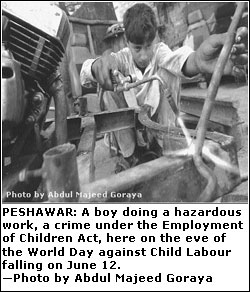 PESHAWAR, June 11: Rights activists have demanded a ban on domestic child labour at homes of government officials. Speaking at a debate held here on Monday in connection with the World Day against Child Labour, they held lack of will on the part of the government, impractical policies and lack of awareness among parents responsible for growing child labour in the country.
There were 36 worst forms of child labour and the government had been unable to eradicate them, said Jehanzeb Khan, regional manager of the Society for the Protection of the Rights of the Child (Sparc). He said the government had signed the Convention on the Rights of the Child, but according to the United Nations Children’s Fund’s data, millions of children were still involved in child labour.
The worst forms of child labour include work in mechanical workshops, construction, waste disposal and chemical sector.
The menace was on the rise because of poverty and parents often used their children as a source of earning, he said.
A labour department official said a survey conducted in 1996 by the International Labour Organization (ILO) and the Bureau of Statistics revealed that there were 1.06 million child labourers in the country and the number must be much higher now. No such survey had been conducted in the recent years, the official said.
The number of such children was much higher as, usually, surveys didn’t include all areas, a participant said.
In the face of growing population, government and non-governmental organisations should work in collaboration to eradicate at least the worst form of child labour, the participants said.
The government should make arrangements for informal education and vocational training of such children, as simply stopping them from working by a law would not solve the problem, they said.
The labour department alone could not eradicate the problem, as a staff of 34 people, including four labour inspectors, could not take action against those who employed children below 14 years of age in the hazardous forms of labour, an official said.
The lack of interest of the government was evident for that fact that the National Steering Committee formed last year under the labour ministry had not conducted a national survey so far, a participant said.
Despite rampant child labour in the NWFP, the legal service unit of the provincial labour department had taken up only eight cases of bonded labour, a participant said.
Only one district vigilance committee had been formed in Mardan under the Abolition of Bonded Labour Act, 1992, and no such body existed in the 23 other districts of the province, said a participant.
The participants said priorities should be set to concentrate on abolishing worst forms of child labour first. Education should be the cornerstone of any preventive strategy, they said.