0
0

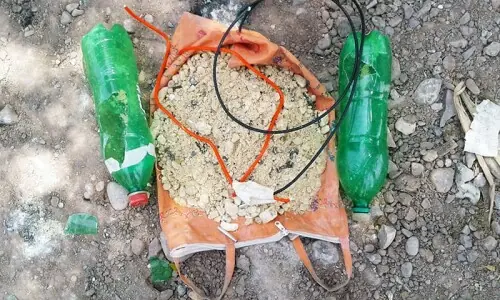
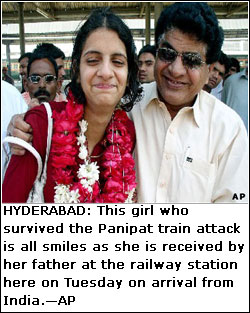 NEW DELHI, Feb 20: Foreign Minister Khurshid Mehmood Kasuri, who arrived here on Tuesday for scheduled talks with his Indian counterpart Pranab Mukherjee, said an important visit had been marred by explosions in a packed train. At least 23 Pakistani passengers heading for the Attari border post from Delhi are feared to have perished in the ensuing fire.
The Indian foreign ministry issued a list of 22 ‘unaccounted for’ Pakistani passengers who were on the train but did not cross India’s Attari border post for Lahore. The total fatalities determined by a body count is 68, indicating that the other victims are in all likelihood Indians who were travelling to Pakistan.
One of the passengers killed by the fire set off by two crude fire bomb explosions in two coaches of the Samjhota Express, was identified separately by the Pakistan High Commission on Monday. The Indian ministry issued a separate list of Pakistani passengers who had crossed the border on Monday after the ordeal on the train from Delhi.
The Haryana state police where the incident occurred issued sketches of two men they believed might have planted the bombs in five compartments of the 14-coach train. The two had apparently jumped off the train shortly before the blasts occurred. Pakistani officials speaking privately felt this did not seem to be a credible line of inquiry as there was no way anyone could have disembarked from a train that does not allow anyone to leave or enter the coaches after it leaves Delhi.
There has been a subdued and generally sober response to the calamaity from both sides and the media has by and large refrained from finger-pointing.
Moments after arriving by a special plane, Mr Kasuri and his delegation went straight to the Safdarjang Hospital, which has a special burns department. They met some of the 11 Pakistani victims being treated there for various degrees of burn injuries. A young boy, one of the passengers brought to Delhi from Panipat, 80 kms north of Delhi, succumbed to his injuries on Tuesday.
"My visit was marred by what happened on the ill-fated train on Monday," Mr Kasuri said at a dinner hosted by High Commissioner Shahid Malik. "Nevertheless, this has strengthened our resolve to fight terrorists of whatever persuasion, where they be. There are extremists in both countries but it is too early to draw firm conclusions about the culprits involved in the train blasts."
Mr Kasuri said Pakistan itself had been a victim of terror, and mentioned the bloodbath in a law court as the most recent example of it. Officials accompanying Mr Kasuri said there could be a joint condemnation of the train blasts in his talk with Mr Mukherjee. Mr Kasuri said the issue was likely to be taken up for a closer scrutiny when officials of the bilateral anti-terror mechanism meet on March 6.
The foreign minister used the high commissioner's dinner, attended among others by former prime ministers V.P. Singh and I.K. Gujral, to indicate the work being done by both sides to arrive at an agreement on Kashmir. "The Kashmir issue cannot be solved by President Musharraf and Prime Minister Manmohan Singh alone. No way. It will need the support of the opposition, the media and the people of both countries."
He broadly hinted that some arrangements were being worked out between the two countries on Kashmir and urged the media and the opposition not to blame the governments for not sharing all the details of the proposals before they were ready for resolution.
During Mr Kasuri's visit, the two countries will sign an agreement on ‘reducing the risk from accidents relating to nuclear weapons’ after the joint commission meeting on Wednesday. This will be the fifth meeting of the joint commission. Terrorism is set to dominate the agenda, officials said.
Indian news agencies said the Pakistan foreign minister who will have discussions with Mr Mukherjee, is expected to present a fresh set of proposals including the one on liberalising the 1974 visa regime between the two countries.
They said the Siachen issue is also likely to come up during discussions between the two foreign ministers. The meeting will be their third during the past four months. The two countries had established a joint commission in March 1983 for strengthening cooperation in various fields. However, only three meetings could be held between 1983 and 1989 after which it did not meet following a downslide in relations between the two countries.
It was revived during President Gen Pervez Musharraf’s visit to India in April 2005. Consequently, Mr Mukherjee had, during his last month’s visit to Pakistan, extended an invitation to Mr Kasuri to visit New Delhi for the joint commission meeting. Six of the eight technical-level joint working groups on agriculture, health, science and technology, information technology and telecommunications, environment and tourism have already met in 2006. The remaining two – on education and information -- will meet this week.