0
0

KARACHI, Sept 26: The provincial education department justified its ban on teachers’ unions and associations by dubbing them as ‘collective bargaining agents’ working in violation of the Civil Servants Act.
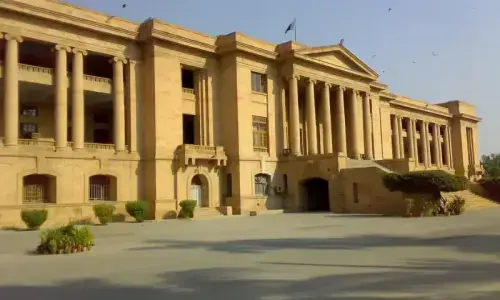
Several petitions challenging the ban and show-cause notices issued to school and college teachers for violating it came up before a division bench of Sindh High Court.
The bench comprising Chief Justice Sabihuddin Ahmed and Justice Yasmeen Abbasy and Additional Advocate-General M. Ahmed Pirzada submitted para-wise comments on the main petition on behalf of a deputy secretary of the education department.
The main petition has been moved by the president of the Sindh Professors and Lecturers Association (SPLA), Prof Syed Riaz Ahsan.
The first petition against a show-cause notice issued to a teacher under the Removal from Service (Special Powers) Ordinance for allegedly violating the ban was filed by Advocate Rasheed A. Razvi. A division bench earlier suspended the notice.
Additional Advocate-General M. Ahmed Pirzada submitted that the education department would like to be represented by a private counsel and a member of M/s Khalid Anwer and Company rose to say that Mr Anwer had already been engaged and sought time for filing comments.
The bench adjourned the hearing to Oct 10 and directed that all identical petitions should be clubbed together for consolidated hearing.
The petitioners assailed the ban for being repugnant to their fundamental rights and a host of constitutional provisions guaranteeing them.
They point out that the ban particularly contravened the provisions ensuring dignity of man, freedom of assembly, freedom of association, freedom of profession and freedom of speech.
In its comments filed on Tuesday, the education department alleged that the banned organizations were functioning as mere bargaining agents for their members in violation of the Civil Servants Act and rules.
According to the department, they have made no contribution to the advancement of the cause of education.
It denied that educational institutions were understaffed or were not being properly managed and supervised or that appointments were being made otherwise than on merit.
The banned organizations, the department maintained, had ruined the academic atmosphere in the province’s institutions and action was taken in ‘the best public interest’.
As for teachers’ associations in other provinces, which were functioning freely, the department said they were not indulging in ‘negative’ and objectionable activities like their Sindhi counterparts.
The court was requested to dismiss the petition as not maintainable because as the July 21 notification imposing a ban on teachers’ associations and unions at various levels was in accordance with rules and ‘a change for better’ had already followed it.