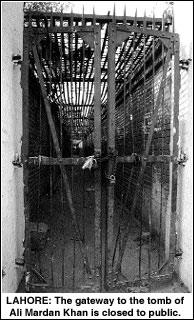
 LAHORE, Feb 12: The gateway to the tomb of Ali Mardan Khan, Emperor Shah Jahan’s famous canal engineer, has been closed “temporarily” to the general public.
The decision to lock the people out of the 17th century monument is said to have been taken jointly by the Pakistan Railways and the Archaeology Department out of the fear that the graves at the vaulted chamber might be idolized out of veneration. PR officials said the gate shall remain locked “till such time that a lasting solution to the problem is found.”
The dome on the road leading to PR Carriage and Locomotive Workshops in Mughalpura is considered a rare manifestation of Mughal architecture. The chamber has three graves. One of them is that of Ali Mardan’s mother. It is located several hundred meters away from the road, adjacent to the mausoleum of Hamid Qadri where an urs is held every year.
For the past few years, Ali Mardan’s cenotaph, too had started attracting devotees. The graves were virtually worshipped and fire was kindled every Thursday. The monument is now opened for cleaning thrice a week.
Senior Archaeology Department officers agree that closing down a monument is no answer to the problem. They say the authorities have gone for the easy solution out of their inability so far to find out a way out.
As Kandhar’s governor under Iran’s Safvid rulers, Ali Mardan Khan had surrendered the province to Saeed Khan, Shah Jahan’s governor of Kabul. When the Mughals annexed Kandahar in 1637, Ali Mardan received a rich reward.
In 1638, he was received in Lahore by Shah Jahan himself at a ceremony for which he ordered his court to be moved to this city. The emperor immediately made him a Shash Hazari (commander of 6,000 troops) and appointed him the governor of Kashmir.
In 1639, Ali Mardan was given the title of Amirul Umra, made a Haft Hazari (commander of 7,000 troops) and appointed viceroy of the Punjab which then stretched from Kabul to Delhi.
Ali Mardan Khan was also an eminent engineer. He is credited with supervising construction of several royal buildings in Kashmir and digging of the Delhi canal, which runs between the Red Fort and the old city. The water supply system of Shalamar Gardens in Kashmir (Gulmarg) was also planned by him.
But the project he is best known for is the hydraulic system of Lahore’s Shalamar Gardens. A canal was brought from Madhopur headworks on the Ravi to the “Versailles of the Punjab.” Water was supplied to the gardens through a three-tier lift irrigation system which was 30 feet higher that the ground level. The hydraulic system was demolished during former chief minister Shahbaz Sharif’s reign. This prompted the United Nations Educational, Scientific and Cultural Organization to notify the Shalamar Gardens, a world heritage monument, as an endangered structure.
Ali Mardan Khan died in April 1657 during a journey to Kashmir. He was buried along the graves of his mother and her maid servant. The land is now owned by Pakistan Railways.
The tomb used to be a unique Mughal structure with a double-storeyed octagonal building in the middle of a luxuriant garden which had red sand stone alcoves in the upper portion. The chambers had petra dura work in the massive marble columns and fresco paintings in walls and ceilings.
The graves were on a three-foot high red sand stone platform beneath a larger than usual dome which was profusely decorated with inlaid precious and semi-precious stones and fresco floral patterns.
The mausoleum later remained in the use of Sikh generals. Gurdit Singh, who commanded Ranjeet Singh’s armies, used it as his residence. Gulab Singh set up an ammunition depot here.
The Sikhs also vandalized the monument. As a result, all the structures except a dilapidated gateway, have disappeared.
Ali Mardan Khan was known for many qualities, including his love of money. Even Emperor Shah Jahan, is reported to have been amazed at learning after his death that his assets amounted to Rs 10 million. Half the amount was forfeited in the name of state. The rest was distributed among his family members.