0
0

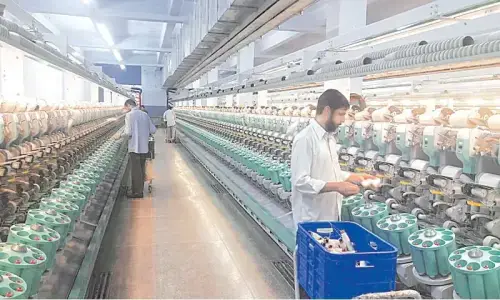
KARACHI, Aug 5: Pakistan’s textile and clothing exports are likely to receive another setback as a Bangladesh task force has recommended new package of incentives that includes tax holidays to make its textile industry more competitive.
The task force, which was constituted by BD government, has recently proposed a package in the wake of US and European Union (EU) plan to waive export restrictions on China in two and a half years.
Bangladesh being a Least Developed Country (LDC) is already enjoying duty-free access for its textiles and clothing to developed Western countries. Besides, the Bangladesh government is also giving some incentives to encourage exports and help maintain share in the world market.
According to reports the task force has recommended doubling of cash incentives to 10pc from the present five per cent (of export value), bank loans with low interest, duty-free import of spares and raw materials and a tax holiday.
On the contrary Pakistani textiles and clothing exports are becoming costlier owing to rapid increase in input costs. A special committee set-up by the Textile Ministry under Zubair Motiwala submitted its recommendations seeking Rs50bn incentive package but the government outrightly rejected it. Major demands made in the recommendation were with regard to cut in mark-up rates, devaluation of the rupee and giving gas to textile industry on reduced rates as was being allowed to the fertiliser industry.
However, on a strong resentment by the industry over the indifferent attitude of the government a revised package of Rs22 to Rs25 billion was announced recently. It allowed one year extension of Research and Development (R&D) of six per cent to garment and knitwear industry, and allowed three per cent R&D on fabric exports and five per cent on home textiles.
Even this was not fully welcomed by the industry, which is of the view that it is too little and too late and above all it should have been across-the-board. Some segments of the textile industry were so much annoyed over the package and termed it to be discriminatory.
Even India last week upgraded its incentive package for its textile industry which was being offered for the last couple of years. It has enhanced the percentages as well as relieves given per kg on textiles and clothing exports across-the-board.
“It seems that all textile producing nations are preparing well ahead of 2008 when there will be no restrictions on export of textile products on any country, including China which even today is the biggest player in the world market,” observed Pakistan Bedwear Exporters Association (PBEA) chairman Shabir Ahmed.
The BD task force has also recommended that tax holiday be extended by another five years, when the country expects to raise textile exports to $15 billion, from more than $7 billion currently.
If a country like Bangladesh, which does not grow cotton and entirely depends on imports of raw materials, is planning well ahead of expected challenges then as to why our ministry of textile is sleeping, he asked.
Mr Shabir was highly critical of the recently announced R&D package and said that by giving R&D to processing, dyeing and printing on home textile products it had favoured a few large groups and excluded majority from this facility.
He said research and development work such as market trends, designs, specialised switching, and brand development was actually done by those who had been excluded from the package.
Zubair Motiwala said that what ever incentive or facility given by the government was immediately taken away by our foreign buyers and in a way we were subsidising consumers of developed countries.
Consequently, he said there was a need to sort out this issue at regional level and at a forum like Saarc to bring to an end the race of giving subsidy or any other sort of cushions to the industry.
He further said that similar issues regarding prices and subsidies at a time were confronted by Far Eastern nations but they were sorted out at Asean forum.
He said there was a need to understand about what competitiveness really means in the world market. “Actually 80pc of the world market goes for competitive prices and only 20pc seeks quality products. This means that we transfer such facility or subsidy to foreign buyers,” he added.