Symbol of neglect

NOTHING quite prepares you for the sensory overload you experience when you move from the pristine and polished Islamabad to the battered and potholed Karachi.
To the discerning eye, Karachi looks like a low-resolution version of Islamabad, that too in sepia tones. The vibrancy of the “City of Lights” is mellowed by the haze of suspended smoke and dust, further muted by the drabness of its infrastructure. Its skyline, characterised by decrepit buildings woven through a not-so-intricate web of overhead wires, pales in comparison with Islamabad’s lush green, hilly landscape.
The sounds of each city also stand in sharp contrast. While the latest and most luxurious private cars noiselessly cruise through Islamabad’s roads, Karachi’s streets are swarmed with motorbikes, rickshaws, buses, and trucks, each incessantly blaring its horn to force its way through traffic. Many private vehicles on the road bear visible signs of abuse inflicted by other heedless drivers.
Both cities have their distinct olfactory signatures as well: while Islamabad exudes privilege and dewy freshness, Karachi reeks of injustice, neglect, and just pure garbage. The stench emanating from gutters, garbage sites, and at times, the sea is so overpowering that even the confines of an air-conditioned car fail to offer any respite from the pungency.
Karachi’s disparity is unfortunate given its economic footprint.
On the development front, as Islamabad witnesses the construction of new underpasses and bridges on a near-monthly basis, Karachi’s infrastructure crumbles under the weight of its burgeoning population, exacerbated by the governance conundrum it faces. The city remains in shambles, ranking 170th out of 173 cities on the EIU’s Global Liveability Index 2026.
This disparity is particularly unfortunate given Karachi’s enormous economic footprint, not to mention its remarkable capacity to embrace people from diverse backgrounds. The city accounts for nearly a quarter of Pakistan’s GDP, compared to Islamabad’s estimated 1-2 per cent. Yet, despite being nearly four times larger in area and having more than 10 times Islamabad’s population, Karachi receives a smaller share of development allocations. Whatever resources are earmarked for the city are further fragmented between the Karachi Metropolitan Corporation (KMC) and provincial authorities, making coordinated urban development all the more difficult.
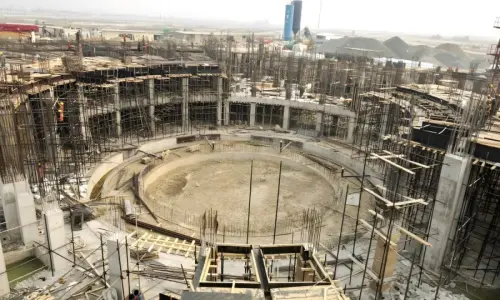
The problem, however, extends far beyond the quantum of development spending. While several new development schemes have been announced for Karachi, those still enduring the (now) five-year-long nightmare of construction along University Road know all too well that such projects bring far greater disruption than promise. Competing political interests, overlapping institutional mandates, and the persistent power struggle between provincial and local authorities undermine the effective and timely implementation of development projects.
Karachi is not simply a poorly developed city; it is an economically indispensable one whose governance arrangements systematically undermine its capacity to convert economic activity into better urban outcomes. The political economy underpinning the disparity between the two cities is hardly difficult to discern. Unlike Islamabad, where the Capital Development Authority provides a relatively centralised structure for urban planning and development, Karachi is governed through a maze of overlapping jurisdictions, with municipal authorities, cantonment boards, development authorities, and provincial departments each vying for greater control. Competing interests and distorted mandates make it difficult to establish who is ultimately responsible for the city’s development, leaving its residents to bear the cost of institutional dysfunction. Moreover, a weak municipal revenue base and limited capacity for own-source revenue mobilisation leave local governments heavily dependent on provincial transfers, further entrenching their fiscal dependence and weakening their capacity to deliver urban services.
It is deeply disheartening to see a city once synonymous with opportunity, enterprise, and the promise of a better life increasingly become a symbol of neglect, deprivation, and urban decay. Karachi needs more than sporadic development schemes and infrastructure projects. It needs empowered local governments, clearly defined institutional responsibilities, and predictable fiscal transfers that allow its elected representatives to plan and deliver services in line with the city’s needs. For a city that contributes so much to the country’s economy, the least it deserves is a governance system capable of delivering the most basic urban amenities.
Karachi deserves better.
The writer is a development economist and policy consultant. She teaches economics at IBA, Karachi.
X: @AroojWDar
Published in Dawn, November 16th, 2026