Resolution on law against Sardari system in Balochistan rejected

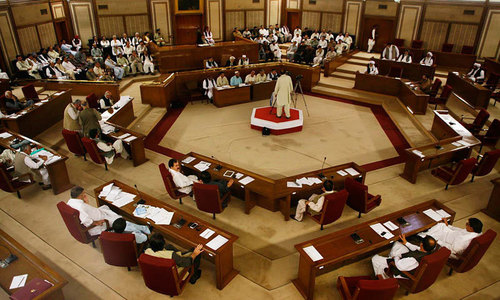
QUETTA: A resolution seeking effective and non-discriminatory implementation of the 1976 Act abolishing the Sardari system in Balochistan was defeated in the provincial assembly by a one-vote majority, with six members opposing it and five supporting it.
Only 11 members were present when Deputy Speaker Ghazala Gola, who was presiding over the session, put the resolution to a vote after a debate. No member pointed out the lack of quorum.
Moving the resolution, Jamaat-i-Islami member Maulana Hidayatur Rehman Baloch said legislation had been enacted in 1976 to abolish the Sardari system and free citizens from tribal domination. He said the law aimed to eliminate illegal powers, coercion and exploitation and protect citizens’ freedom, equality, autonomy and legal rights.
Balochistan lawmakers divided over feudal system
He said that despite the law, people in some areas of Balochistan continued to face threats, pressure, forced decisions, social and economic exploitation and restrictions on personal freedoms in the name of Sardari and tribal influence.
He said human freedom, dignity and the right to make independent decisions were both constitutional requirements and fundamental Islamic principles.
The resolution recommended that the provincial government ensure effective and non-discriminatory implementation of the 1976 Act throughout Balochistan.
Speaking on the resolution, Maulana Hidayatur Rehman said: “We are not against the tribal system; it is our identity. We are against the Sardari system introduced by Sandeman.”
He said that despite there being 140 sardars, none could save the father of Asma Jattak. He added that the youth of Balochistan rejected the Sardari system, which survived with the support of the establishment and the government. He demanded a ban on the titles Sardar and Nawab.
Minister Mir Zahoor Buledi said no one opposed nawabs and sardars as individuals, but some incidents had exposed violations of people’s human rights. “We are against this attitude and oppose it,” he said.
Opposition leader Mir Younis Aziz Zehri said a similar resolution had been moved in the previous session, adding that the language subsequently used by its mover on social media and at press conferences was inappropriate.
He said he had contested the 2013 election against Nawab Sanaullah Khan Zehri and had again won against sardars and nawabs. He added that the JUI had always opposed oppressive nawabs and sardars.
“We are against murderers, cruel nawabs, sardars and those who robbed the public of their representation through Form-47,” he said.
He also recalled the sacrifices made by the JUI in the Asma Jattak case, saying Wadera Ghulam Sarwar Musiani, his nephew Kamran Jattak and Mulla Amanullah had been martyred for the same cause. He said no sardar was above the Constitution or the courts. Minister Ali Madad Jattak supported the resolution, saying the 1976 Act had abolished the system. He said some sardars settled disputes, while others committed acts of cruelty.
PML-N member Zarak Mandokhail opposed the resolution, arguing that the system was centuries old and could not be abolished. He said some sardars and nawabs also financed young people’s higher education in Pakistan and abroad.
PPP member Samad Gorgage supported the resolution against the Sardari system previously moved and passed by Sardar Attaullah Khan Mengal.
JUI-F member Dr Nawaz Kibzai said a sardar was the elder of his tribe and questioned which sardar had failed to provide schools, hospitals, roads and development facilities in his area. He also requested that unparliamentary remarks against sardars be expunged from the record. The Deputy Speaker ordered their removal.
JUI-F member Zahid Ali Reki and BAP member Farah Azeem Shah also spoke. The deputy speaker subsequently put the resolution to a vote and declared it rejected after it failed to secure a majority.
Published in Dawn, November 15th, 2026