0
0

 KARACHI, Aug 3: Fearing an outbreak of waterborne and food borne diseases in the wake of the ongoing spell of monsoon rains in the city, experts have called for keeping an eye on the quality of water and edibles citizens consume nowadays.
“Since our surroundings are dirty and water and sanitation systems are unpredictable there is a fair possibility of rise in the number of waterborne diseases in the city and as such people should not take fever, headache, gastrointestinal discomforts, vomiting and diarrhea lightly,” said an expert at a private hospital.
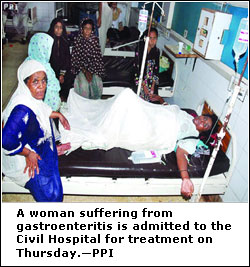
A survey of some government and private hospitals revealed that cases of gastroenteritis, including adults and children, had been brought to hospitals during the last couple of days from different localities, including Lyari, Macchar Colony, New Karachi, Korangi, Federal B Area and Orangi Town.
The health EDO of the city government, Khalid Shaikh, said that so far the situation at medical centers and hospitals in his jurisdiction was under control, but staffs had been told there to stay alert to handle any untoward situation. Very shortly, we will start fumigation and spray activities as well, he informed.
An official at the Abbasi Shaheed Hospital said that 41 patients with history of vomiting and loose motions were brought to the hospital on Wednesday, of which adults were released after initial aids while a majority of the minors were kept under observation.
Based on the number of cases reported till Thursday noon it can be speculated that Thursday would receive waterborne cases more as compared to Wednesday, said the official located at the medical superintendent office of the hospital.
A doctor from the NICH’s emergency section told Dawn in the afternoon that so far he had received 30 children with gastro-intestine problems from various parts of the city, 70 per cent of whom had been detained for further treatment.
People coming along the children said that they had been receiving turbid water after rains in their residential areas, he replied to a question.
Doctors at the JMPC casualty said that they had received patients with the history of fever, respiratory problems, stomachaches, but the situation was not very alarming, they claimed. The gastro cases are still within the trend, said a senior doctor, asking people to consume boiled water and well cooked food to avert any health adversity in the wake of the monsoon showers.
However, Dr Zaheer Hussain, chief medical officer at the Lyari General Hospital, said that the number of gastro patients was on the rise in his hospital. Today, like Wednesday, we have received so far (around 2.30pm) 50 patients, in addition to 50 children who were handled at the child unit of the hospital, mostly coming from Lyari and Macchar Colony, and affected due to the consumption of turbid water, he added quoting the attendants.
Dr Kaleem Butt, medical officer of the Civil Hospital Karachi, said that the hospital too had started receiving patients with symptoms of waterborne diseases after the beginning of rains, but he felt that there was nothing to worry.
Our doctors are already alert while medicines are at the disposal of the emergency and medical wards’ staff as the number of gastro patients may further increase in the days to come, he added.
Health experts said waterborne diseases might be endemic to the city and there was a need to remain watchful about gastroenteritis, hepatitis, typhoid, amebiosis, a form of diarrhoea, and cholera, which were among the main waterborne diseases.
A doctor said that diarrhoea, high fever, typhoid, and jaundice were the feature of the monsoon, which could be attributed to insects, bacteria and viruses that thrived in monsoon environment or attracted to water bodies and shattered sanitation.
Dr Qamrul Arifeen of the Liaquat National Hospital said that reporting of the gastro cases at his hospital was marginal. He advised the citizens to consume only boiled water otherwise it would be a serious health risk.
Referring to the turbidity factor in river and dam water that the city receives for drinking purposes, he remarked that in addition to that the chances of contaminations in drinking water was also high as sewer and water supply ends were open in many cases. To survive, we need proper monitoring of both the sewer discharge and water supply system for the city, he added, advising people to ensure proper treatment of water before consumption.
Doctors in general were of the view that cases of gastroenteritis took place only when people turned indifferent to water and food they consumed. They said that children should also be refrained from swimming or dipping in the stagnant water or puddles as it was tantamount to inviting waterborne diseases.
According to an expert, turbidity is included in some of the most obvious water problems which were also the easiest to solve. Turbidity affects the look and taste of the water, and may cause it to be undrinkable by some people's standards, he further noted.
Several methods to treat turbid water included use of an activated carbon filter which are designed to remove solid particles from the water. Most taste and odor problems can be reduced with the use of such filters.
The most cost-effective method of reducing the haziness of turbid water is treating alum. If one can afford, he or she should first get the water filtered through equipments available from the market, then boil it and again pass it through thin fabric to withhold the precipitated matters, concluded a senior doctor.